
2026 JULY ISSUE
THE TAIWAN STRAIT
THE FAULTLINE OF
ARTIFICIAL INTELLIGENCE ERA

Written by ANDREW SIA
Share this article !
From the Desk of the Publisher

Without question, artificial intelligence has now entered nearly every sector of modern life, driven by increasingly powerful computer chips that form the backbone of this technological revolution. Yet, behind this remarkable progress lies a structure imbalance. The supply of these critical components is heavily concentrated in East Asia, with Taiwan holding a dominant position in advanced semiconductor production.
The concentration is not merely an economic detail — it is a strategic reality that deserves careful attention. As we have seen in the global energy markets, where disruptions in the Middle East can affect the flow of oil and gas to the world, independence on a narrowly concentrated supply chain carries in inherent risks.
The question before us is not whether artificial intelligence will continue to advance as it certainly will. But whether its foundation is resilient enough to withstand the geopolitical uncertainties that define our time. It is this tension that calls for closer reflection and deeper understanding.
It is within this tension between innovation and dependency that the true story of the AI era begins.

Introduction
The rise of artificial intelligence reveals a paradox at the heart of modern economies: while innovation drives growth and prosperity, it also deepens structure dependencies that challenge long-term resilience.
The Economic Surge and Imbalance

The rapid rise of artificial intelligence has provided strong momentum to the U.S. stock market and the broader economy. However, it has also contributed to structural imbalances, particularly in trade.
Imports of computers, semiconductors, and related components exceeded $450 billion over the past year. As a result, the overall trade deficit of the U.S. reached $1.2 trillion in 2025, representing a significant increase.
A substantial portion of this imbalance is tied to advanced semiconductor imports, especially from Taiwan. The U.S. trade deficit with Taiwan alone doubled to around $146 billion, reflecting the growing dependence on high-performance chips essential for AI development. Total U.S. imports reached approximately $3.4 trillion in 2025.
Since returning to office, Donald Trump has pursued a policy of imposing tariffs on key trading partners. However, electronics — particularly semiconductors — have largely been exempted due to their critical role in domestic industries. As a result, this segment is expected to remain a significant contributor to the trade deficit in 2026.
The Infrastructure of AI
At the same time, demand for computer power continues to surge. AI-driven data centers are expanding rapidly across North America, with more than 35 gigawatts currently under construction. The level of capacity is comparable to the annual electricity consumption for entire countries such as Britain or Italy.
Recognizing these vulnerabilities, both the Biden and Trump administrations have tried to expand domestic semiconductor production. However, such efforts require long-term investment and are unlikely to yield immediate results. The U.S. Commerce Secretary Howard Lutnick has suggested that as much as 40% of Taiwan’s chip production should be relocated to the U.S. within the next three years. It is an ambitious and challenging objective.
The Concentration Risk
As we move deeper into the rise of artificial intelligence, we cannot separate technological advancement from the geopolitical realities that underpin it
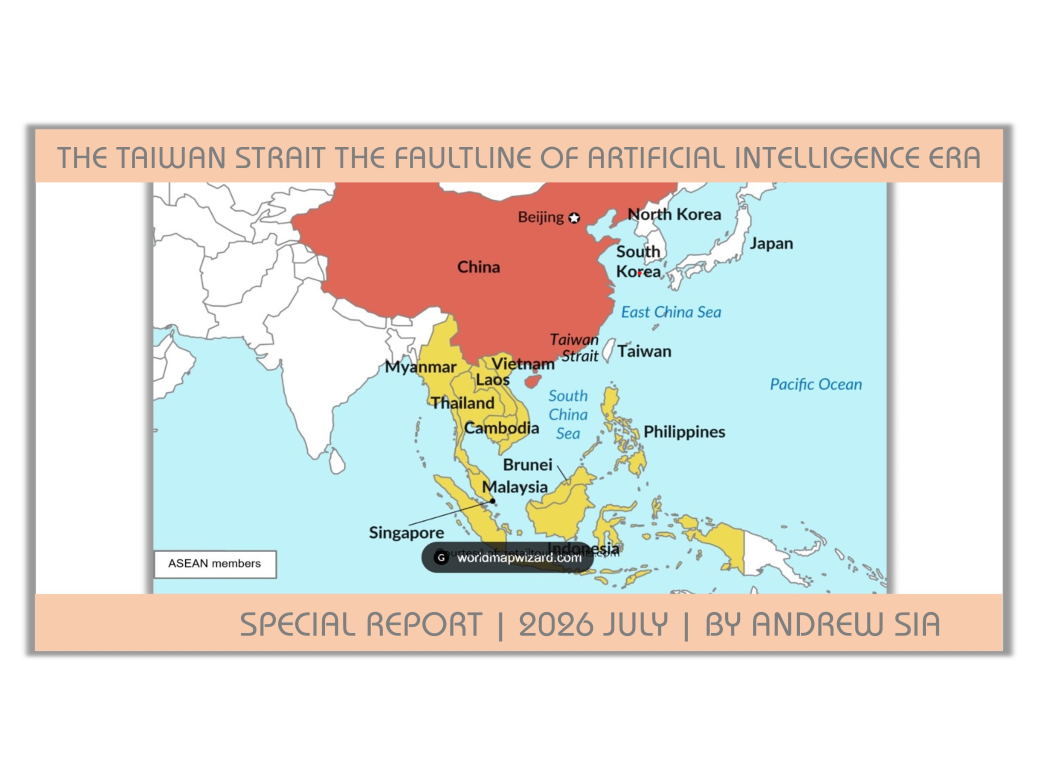
At the center of this tension lies the Taiwan Strait. A significant portion of the world’s most advanced semiconductors is produced by TSMC, making it a critical node in the global technology supply chain. This concentration of capability introduces a level of vulnerability that cannot be ignored.
There is also a sense of strategic hesitation among industry leaders. The expansion of production, the relocation of manufacturing, and the alignment of national interest are all unfolding under complex and often competing pressures. Companies such as Nvidia continue to push the boundaries of AI innovation, yet the broader ecosystem remains dependent on a fragile balance of global cooperation.
This raises an important question: how resilient is the foundation upon which the AI revolution is being built?
The current structure is not without strength, but it is highly concentrated. Should geopolitical tensions escalate in the Taiwan Strait, the implications for global technology supply — and by extension, the world economy — would be profound.
We may draw a comparison with the Strait of Hormuz, where disruptions to the flow of oil and gas can affect the global market. In a similar way, both straits are critical to the global economy as they are geopolitically concentrated and strategically sensitive. We have witnessed the Strait of Hormuz representing the critical chock point in the modern economy, and the Strait of Taiwan can be another chock point for the modern technology.
In time of international conflict — especially those with global consequences — leaders must rise above division with a spirit of responsibility and benevolence, coming together at the negotiation table. Threats and confrontation should give way to dialogue and solutions that should lead to mutual understanding. At such critical moments, empathy is not weakness, but a necessity.
Conclusion
Artificial intelligence rests upon a fragile geopolitical foundation. The heavy concentration of semiconductor production in Taiwan has created a level of dependency that is difficult to ignore. Should conditions in the region changed, the implications would be significant.
While there are other microchip producers’ countries such as South Korea and Japan, advance semiconductor manufacturing remains largely concentrated within East Asia. This regional cluster introduces systemic risk, particularly in areas shaped by complex geopolitical dynamics.
The proximity to contested waters, including the South China Sea, and the growing strategic presence of China further heighten these concerns. At present, viable alternatives remain limited, underscoring the extent of global dependence on this concentrated supply chain.
Our alternatives are limited, but not completely helpless as the U.S., Europe, and others are investing in domestic chips manufacturing. Samsung in South Korea is a significant player, and Japan is re-entering in this computer chip arena.
We come to accept that AI revolution is global, but its foundation remains regionally concentrated. We have to look for diversification.
Epilogue of The Taiwan Strait – The Fault Line of the AI Era
Literally, a fault line is a fracture in the Earth’s crust where tectonic plates meet. These areas appear stable on the surface, yet pressure silently builds underneath until an earthquake occurs. And Taiwan is literally located along major tectonic fault zones where the Philippine Sea Plate and the Eurasia Plate meet. That is why Taiwan experiences frequent earthquakes. It has steep mountain ranges and sits within the Pacific “Ring of Fire.” The island was largely formed by tectonic collision and uplift over millions of years. Taiwan is physically sitting on geological fault lines.
This time, Taiwan Strait can also be described as a place where enormous geopolitical, technological, economical, and even military pressures are converging.
The world is economically connected, but beneath the surface there are dangerous tensions, and because it is technologically advanced, Taiwan has become the critical pressure point of the AI age.
Taiwan is sitting at the center of several tectonic plates of our modern civilization, namely, the technological fault line, geopolitical fault line, economical fault line, and civilization fault line. We can refer them more deeply as the following:
Technology Fault Line – Taiwan, especially Taiwan Semiconductor Manufacturing Company, produces many of the world’s most advanced semiconductors. Our AI systems, cloud computing, smartphones, military systems, and data centers are all depending on these chips. We come to realize that Taiwan Strait is not merely a regional issue anymore, but it is becoming a structural vulnerability for the entire digital world.
Geopolitical Fault Line – The Taiwan Strait sits between China’s rising, American strategic influence, Asian security alliances, and global trade routes. The pressure continues to build military exercises, naval patrols, sanctions, technological restrictions, and economical decoupling. One miscalculation could send shockwaves through the global economy.
Economic Fault Line – Our modern globalization depends on uninterrupted semiconductor supply. It powers the industrial age and also powers the AI age. We can compare the Strait of Hormuz for oil with the Taiwan Strait for semiconductors.
Civilizational Fault Line – Our human civilization is entering into a dangerous transitional period, where AI promises intelligence, automation, wealth, and scientific advancement, but it also brings over-dependency, too much concentration of power, creates strategic fragility, and geopolitical rivalry.
With all these, we bring you the main piece featuring “The Taiwan Strait – The Fault Line of Artificial Intelligence Era.”