
2026 JANUARY ISSUE
MARKET INTELLIGENCE
SHORT READ
| PART 3

Contents:
Wellness Market in Trending the Retail Space
Who Are Those Top-Tier Malls in the US?
Reviewing the Models of Shopping Malls
More on Malls That Are Performing Better
LVMH, the Bellwether, is Taking the Hit from the War
Deflation is Taking Place in China
JD.com Has Landed in Europe
Nike’s Latest Fiscal Report
US Retail Space Distribution
Allbirds Changed Hands
More About Nike’s Competitive World
UEFA Champions League’s Sponsorship is Changed from Adidas to Nike
Written by Andrew Sia
Share this article !
From the Desk of the Publisher

Without question that the retail industry is reinventing itself after the market emerged from the Covid pandemic. During the time, a group of the aspirational shoppers were developed, but now they have to come to the reality and decide what are really the necessities that they would need to focus.
We spent some space to report the reinvigoration of Nike and have found that they are now back again in the sporting world where they are picking up the leading role.
I would say that the fashion arena is still full of opportunities disregard with all the challenges that we have been reading. I believe that soon these will be over and only with those with the sober mind will survive.

Wellness Market is Trending the Retail Space – WSJ, March 18, 2025

Retail leasing by service-oriented tenants outpaced goods-based retail leasing for the first time ever in this big city — New York. It is a reversal driven in large part by a proliferation of salons, spas, and fitness studios.
Service-based tenants already leased just over 50% of total retail footage in 2025.
Perhaps we can explain how e-commerce has reduced the amount of physical space that retailers need to sell their products.
On the other hand, the big components in the sector — restaurants and bars — are not doing great because the spendings have been pulling back under the current economic situation.
Wellness is a rapidly growing market in the U.S. totaling $2.1 trillion in 2024 in according to the non-profit Global Wellness Institute. This institute measures spending on sectors like spas, beauty, nutrition, mental wellness, and public health. New businesses are meeting the growing demands in shops for laser facials, IV hydration and vitamin infusions, Botox, and red-light therapy.
Fitness-center openings have surged, with the sector making up nearly 30% of service-based leases.
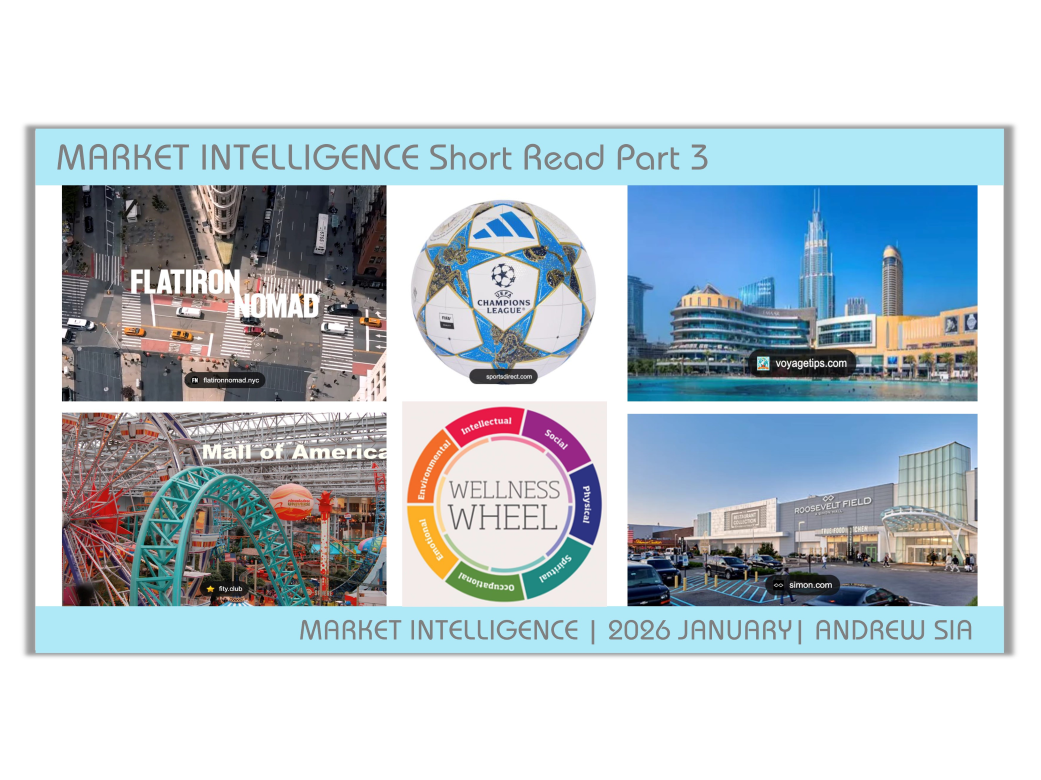
In Manhattan’s Flatiron and NoMad neighborhoods, self-care and fitness brands have leased 100,000 square feet in the past two years. The streets are dotted with saunas, and Pilates studios.
This trending is showing us service tenants now outpace goods retailers — restaurants, fitness, medical, banking, etc. The leasing space under 3,500 square feet is now standard.
Cities that are struggling are Chicago, San Francisco, and DC, where we find higher vacancies and weak daytime foot traffic due to remote work.
Cities like Miami and Los Angeles where tourist traffic is still heavy and their high streets are thriving, where luxury shopping, fine dining, and experimental retailing are dominating. High street retail still works in those cities because of foot traffic from tourism, residents, and offices is strong.
We have seen secondary and fast-growing cities like Dallas, Phoenix, and Atlanta, where these cities are gaining population. The retail is expanding, and High Streets are being created. These cities are driven by migration from coastal cities where demand has been created. More lifestyle centers and mixed-use, like the “live-work-play” retailing has been introduced.
In smaller towns where people still prefer in-store shopping as retail is more necessity-driven. E-commerce is less dominant in smaller towns. We can find their main street has strong demand for grocery, personal services — salons, clinics and repair shops — and local restaurants.
On the whole, people are looking for tourist towns, affluent neighborhood, and curated mix of boutiques, new experience in dining, and mix with entertainment.
Who Are Those Top-Tier Malls in the US?

We have textbook examples of the three top-tier malls. I am referring to Mall of America in Minnesota, American Dream in New Jersey, and King of Prussia Mall in Pennsylvania.
Mall of America – Classification A++ and it is an experimental destination mall with 5.6 million square feet. It is one of the largest malls in the U.S. with massive entertainment component like theme parks and aquarium, etc.
It is a tourist destination that draws visitors nationally and internationally. It is also extremely diversified with retail, entertainment and hospitality. It began as an “experience mall” that inspires others to replicate.
American Dream – Classification A but it is still trying to stabilize and is also evolving. It is about 3 million square feet, and it is heavily focused as being an entertainment-centric mall with indoor ski slope, water park, etc.
It is designed as a next-generation destination like the Mall of America. It is still working through its tenant-mix, foot traffic consistency, and financial stability and it has less proven track record than the others.
King of Prussia Mall – Classification A++ and it is purely a retail mall. It has 2.9 million square feet, and it is the largest retail mall in the U.S. It has minimal entertainment compared with the others. It is among the highest sales per square foot in the country. It is dominated with luxury and premium retail mix.
It is serving a very affluent trade area in the suburbs of Philadelphia. It is also a standard of a traditional retail-focused A-mall.
Reviewing the Models of Shopping Malls
We are referring to classic suburban mall model — long corridors with big anchor department stores at each end pulling foot traffic through the shopping mall. This model has been under real pressure for years, even before the pandemic, and what is happening now is divided into three different trends — “winners”, “reinventions”, and “failures”.
Anchor stores like Sears, JCPenney, and Macy’s have closed and downsized. They became victims of e-commerce and changing of shopping habits. Once their positions have weakened, the smaller tenants are suffering and resulted to close. The entire mall ecosystem started to unravel.
The tenants like, gyms and fitness centers, entertainment venues — bowling, indoor amusement parks, and cinemas, food halls, and larger restaurants — have surged to bring in the mall foot traffic. Popular ones are Lifetime Fitness, Dave & Bustler’s, ROUND 1 Bowling & Arcade, Barcade, Main Event, and Bowlero. These are arcade game and consoles and a mix of modern and classic arcade gaming experiences and provide popular alternatives for social activities.
For gaming and activities, we have The Funplex, Yestercades for retro games. We also have RPM Raceway for go-karting.
It is so important that it has not just bring in the mall traffic, but to find the way to keep people on-site longer. The malls have evolved now towards the establishing of offices and coworking offices, medical centers, apartments and hotels, and even educational/training centers, and churches. Think of a downtown environment rather than just a shopping destination.
For those A-malls they can be destined and pivoted to luxury shopping, dining, and better experiences for lifestyle. The B-malls can become traditional malls, community centers, and mix with services.
Some malls, the least popular ones, the C and D-malls, are converted into warehouses, and distribution centers for e-commerce.
So that we know, we have the following tiers of shopping malls in the U.S.:
A-mall (top-tier mall), we have roughly 800,000 to 2 million square feet with sales of $600 to $1,000 per square foot.
B-mall (mid-tier mall), 400,000 to 800,000 square feet with sales $300 to $600 per square foot.
C-mall (struggling mall), 200,000 to 500,000 square feet with sales $150 to $300 per square foot.
D-mall (distress mall), 400,000 square feet with sales below $150 per square foot.
More on Malls That Are Performing Better – New York Times, March 24, 2026

Simon Property Group owns the most class A in the country. Roosevelt Field Mall, a property east of New York City, has a 96.3% occupancy rate and has tenants like Armani, Hermès, Rolex and Savage X Fenty. It can rent out the space at $1,250 per square foot and the store fronts are in high demand.
Real estate firms are trying to find out the ways to attract high end customers to visit the stores and Simon Property Group has seen its stock price double in three years. Its revenue rises nearly 6% year-over-year.
There are roughly 900 malls in the United States, but only very few are successful. The top 100 account for 50% of the sector’s total value, whereas the bottom 350 make up only 10%. Revenue at class A malls is growing by 5% each year and commercial mortgage for this market has doubled from $4 billion in 2024 to roughly $8 billion in 2025.
Like most American malls, Palisades Center, a sprawling four-story mall complex in Hudson Valley is struggling. In the early 2000s it was valued at over $880 million, and it was drawing 24 million shoppers per year. It has a skating rink, but after bearing the heavy debt, and the leaving of its anchor tenant, including JCPenney, the troubled mall was sold at auction for $175 million.
Malls that are shrinking by about 5% a year in revenue is labelled “Class B” or “Class C” mall. These distressed malls are bothered by delinquent loans as they have difficulties in signing tenants and this plunge the value.
The pandemic accelerated the downward trend of these lower-tier malls, and CBL Properties, Washington Prime Group, and Pennsylvania Real Estate Investment Trust all declared bankruptcy from 2020 to 2023.
It is the Gen Z who is going for in-person shopping, and this as handful of the malls are inexpertly winning big on a very specific type of mall.
Raising the malls into luxury shopping destinations have also been successful in some cases. Reinvigorate the shopping experience by stay-at-home-entertainment launched Netflix House in Dallas and Philadelphia that showcase interactive experiences relating to hit shows — “Stranger Things,” “Wednesday,” and “Squid Game.”
It is said that 58% of shoppers aged 18 to 34 shop at mall more often than adults over 55. The malls that are curated, diversified, and offering entertainments are more successful.
LVMH, the Bellwether, is Taking the Hit from the War

The Dubai Mall is in the world’s tallest building where you can find all the luxury brands. In recent years, Dubai emerged as the most powerful growth engine in the Middle East, and half of the sales come from the United Arab Emirates.
Since the war of the U.S.-Israeli with Iran, there are very few shoppers in the shopping mall. The attack from Iran through the drones scares away the tourists and creates a crisis for luxury brands and it is reported that half of the sales dropped because of the lack of foreign tourists.
Dubai’s shopping is dominated by two opulent centers — the Dubai Mall and Mall of the Emirates. The two malls receive more than 140 million visitors each year.
Global luxury market sales stagnated in Asia and Europe over the past couple of years and the Middle East accounts for a certain share of luxury sales. The prolonged war could jeopardize billions of dollars in luxury sales. Iranian attacks escalated across the Persian Gulf nations, including Bahrain, Kuwait, and the Emirates is posting a threat.
Luxury conglomerates such as LVMH Moët Hennessy Louis Vuitton have spent years developing its business relationship in Dubai. It has added more stores in Dubai’s malls and airport. From a report of Visa, it showed that about one in every nine Dubai residents made at least one luxury retail purchase every three months. It is a greater share than those who live in New York, London, Paris, or Singapore.
The war with Iran has caused the stock drop in Q1 2026, and it is showing the following:
LVMH: –28%
Richemont (Cartier): –20%
Kering (Gucci): –17%
Hermès: –25%
We have noticed that LVMH is taking the biggest dive as it is more exposed to aspirational spenders. The Middle East conflict isn’t just a regional issue as it is affecting travel, tourism, and it affects the people from spending. And then the historical growth of China at one time was +30% is not happening anymore.
The drop is also showing many signals for the weaker demand of luxury brands, the global economic sentiment, China’s market change, and the war in Middle East. It is the result of too many negative effects that have brought the market down.
Deflation is Taking Place in China – WSJ, January 29, 2026

Across China’s economy, consumers aren’t spending enough, but producers continue to produce, leaving the companies along the supply chain earning less. Many feel they have no choice but to lower prices to unload inventory. This is causing the shrinking of profit before their eyes.
In Shanghai, hundreds of vendors at Shanghai’s largest clothing market were busy processing returns. It is the Qipu Road Wholesale Clothing Market where wholesalers send shipments of sweaters, dresses and pants to retailers all over the country. Stores pay only for what they have sold and send back what they don’t.
Lately the vendors all cry for poor sales. A womenswear wholesaler estimated her 2025 revenue was about half of what she made the prior year. It was even better during the pandemic, but this time it is really hitting hard.
China managed to keep overall economic growth steady at 5% last year. The country is also trying to promote cutting-edge technology from artificial intelligence to robotics. Its ability to produce rare-earth minerals creating the leading edge to its capability in the trade war with the U.S. But its relentless pursuit of growth through manufacturing has created a lopsided economy with much of it being caught with the deflationary spiral. Its inadequate demand at home has deflated its GDP. Across a wide range of industries — steel, concrete, electric vehicles, robotics, condiments and cosmetic, have all shown shrinking profits. Publicly traded companies are at their lowest levels since 2009 according to a FactSet index of 5,000 mainland-domicile firms.
Its fixed-asset investment also fell for the first time in 2025.
The risk that China may enter into a prolonged period of stagnation similar to what Japan experienced during the 1990s and early 2000s.
Deflation is increasingly a geopolitical liability, and Chinese exporters have exported more to reach a record of $1.2 trillion trade surplus in 2025. This is the behavior of dumping its excess capacity across all product categories and it has created government from across the world are complaining about an influx of cheap Chinese goods. China failed to achieve their domestic demand which they claimed as their top priority.
The country’s next five-year plan aimed to boost household spending, and also prioritized technology, manufacturing and industrial self-efficiency, and this leads to overproduction in many cases. It is Beijing who sets the economic goals, provincial and municipalities would compete among themselves to show their achievements. Businesses get cheap loans from Chinese banks and also tax breaks.
But Chinese citizens can only get very low health insurance and minimal pensions that don’t allow them to spend too much on the household and other expenses. China’s household spending makes up only 40% of China’s gross domestic product in 2024, compared with a world average of 55%, and a U.S. average of 68% according to the World Bank. Chinese also tend to buy their own property, and it is getting more difficult in these days due to the hardship, although the real estate market is down from its peak three years ago due to the overcapacity.
In the auto sector, China has more than 100 EV manufacturers as the government identified it as a strategic sector in the early beginning. It is now not selling well in China, and the makers are dumping the prices in every market, be it the Middle East, Central Asia and Africa.
Businesses are limiting wage growth, cutting workers, and stop hiring.
JD.com Has Landed in Europe – FT, March 17, 2026

JD.com is Chinese largest commerce group is launching a European version of the retail business. This expansion is to drive for the group’s business expansion and on the other hand, to become less reliance on an increasing domestic market.
Last year, JD.com bought the German electronics retailer Ceconomy for €2.2 billion last year. It has also explored options for UK retailers like Currys and Argos but has not reached any deals yet. It is easy to understand as the domestic market has become stagnant and looking for growth outside China is an opportunity.
This expansion for JD.com in the international market is the largest operation it is launching. With more than 100,000 products ranging from high-end brands such as Apple to groceries in six European countries. It is operating under the Joybuy brand, and it promises to deliver products in matter of hours.
This also comes at the time when China is suffering from slow economy growth, ecommerce group Alibaba is offering discounts in an attempt to seize market share from market leader, Meituan, for food delivery. JD.com reported for the first quarterly report for a loss in almost four years. Its shares have lost a third of its value in the past year.
With JD.com’s presence in the UK, Germany, France, Belgium, Luxembourg, and the Netherlands with more than 60 warehouses covering 300,000 square meters and more than 49,000 lockers across Europe. It has also equipped its warehouses with robots from China to pick goods.
With Joybuy’s presence in Europe, it is going to compete with Amazon, and not to forget that there are already competitors like Shein and Temu, who have established there.
Nike’s Latest Fiscal Report – FT, April 2, 2026
Nike is saying that its Q4 expected revenue will decline 2-4% for obvious reasons. There is the war now in the Middle East, and the sales in China would be down about 20%. Its president and CEO, Elliott Hill, was recruited out of retirement in 2024 to attempt a turnaround to prioritize running, basketball and football across its portfolio.
Nike has experienced sales declines in China for seven straight quarters, which would remain a weak point throughout the next fiscal year. In China, it is facing stiff competitions from Anta and Li Ning offering similar athletic footwear at significantly lower prices.
But other brands, like On and Hoka, continue to grow, while Adidas is introducing more locally designed sportswear.
Nike’s fiscal year 2025 was $46.3 billion, representing a 10% decline compared to 2024. The recent Q3 2026 result, ended February 28, 2026, showed a revenue of $11.28 billion, which was flat year-on-year. It is facing declining sales in its direct-to-consumer digital channel.
We have to know that Nike is still the world’s largest and most valuable sports by a very wide margin, and it is double the revenue of its closest competitor, Adidas, commanding around 39% of the global market. Nike leads in global footwear and apparel.
US Retail Space Distribution – WSJ, March 18, 2026
Retail leasing by service-oriented tenants, such as spas and gyms, outpaced those goods-based retail leasing, accounting for just over 50% of total square footage. Would the trend continue?

Allbirds Changed Hands – WSJ, April 1, 2026

Once known as the buzzy maker of merino wool sneakers was sold for $39 million. It was a huge comedown for a company that was valued at $4 billion when it went public in 2021.
It was founded in 2016 by Joey Zwillinger, an industrial engineer, and Tim Brown, a former professional soccer player. It picked up a hyper fast growth model pioneered by the online disruptors that sold goods directly to consumers, and it became too costly.
The brand was riding on the waves of the 2021s direct-to-consumer start-up boom in the Bay Area. The company’s success was driven by Silicon hype. It began to introduce new products, including workout gear made out of wool. The wool legging turned out to be see-through, ended with tens of thousands being unsold.
Allbirds tried to offer more technical sneakers in brighter colors and edgier patterns designed to attract younger customers. It also tried to expand into other categories — underwear, puffer jackets, and golf shoes — without much success. The loyal customers in Silicon Valley lost interest.
The company lost 95% of its value since it went for IPO in 2021.
Allbirds was funded by venture capital investment, had opened 15 stores by the late 2019. By 2023, it had 60 shops worldwide. Since then, all of its U.S. stores have been closed, except the two outlet stores. It tried to spin-off its products by using eucalyptus tree fiber pulp but failed to draw the interest from the customers.
Since going public, it has not been able to turn into a profit, and it reported $77 million in net losses last year.
With the changing of the ownership when it was sold on March 30 to American Exchange Group for $39 million after securing $50 million for refinancing and renamed as NewBird AI for going forward. The new owners could have hoped the tech workers would favor the type sneakers that it was known before.
I read this from someone who is a sustainability consultant for fashion and sourcing that first of all the product’s quality is unsustainable. The sneaker was found to have fallen apart in three months. Their failure to correct the issues caused bigger problems for their choice of materials and the manufacturing execution.
Allbirds went for IPO in 2021, It rode on being a new company, fast-growing, and took the advantage of its presence in Silicon Valley and gained popularity among those tech-players. Overhyped pricing, lack of track record, helped for Allbirds’ successful launching, but posted the risk that took place afterwards. The IPO set it on a course to failure.
It was seen as sustainable, and recognized as “Silicon Valley cool,” and investors priced it as a high-growth tech-like product. But it is still a footwear company with real-world limits.
It is unlike Nike, known for its performance and innovation, or Lululemon for lifestyle and purpose driven. As a direct-to-customer (DTC) business model, it is depending on its spending on marketing, which makes it expensive, and when its margin being squeezed it moved into physical stores, but the operation didn’t generate enough return on investment.
We can only say that Allbirds succeed as a concept but struggle as a scalable business. Its story resonated, but its product and economics could not sustain its long-term growth. It was hoping to use the IPO to push the company to its next level, but overvaluation can’t sustain its intention, and its limited variety that is not performance oriented. We have to learn that a brand can only survive on its fundamentals.
More About Nike’s Competitive World

We must appreciate that as a brand alone, Nike market cap for 2025 was $114.3 billion. The combined market cap for the following sportswear brands was:
Adidas – $34.7 billion
Anta Sport – $34.2 billion
Lululemon Athleisure – $24.2 billion
Asics – $19.5 billio
Total combined – $112.6 billion
Nike’s total revenue for 2024 was $51.36 billion, while the rest of the four brands were $50.99 billion.
We have to admit that Nike continues to lead the industry in both its market cap as well as its revenue. We come to know that Rome wasn’t built in one day and there are so many successful elements behind these facts, and we can look in some of the following areas:
Nike has one of the most complex and detailed operation set up in the world, spanning across more than 500 factories in 40 countries. It is not just cost effective, but also in demand in several countries and regions for having the products closer to the market as well. This is a very clever move.
Unlike Anta, whose recent acquisitions of Salomon, Arc’teryx, and Fila Asia, in its portfolio which allowed them to expand their market presence through buying the market share without building from scratches.
Nike’s brand strategy is very successful. Also, its brand equity’s role in pricing, and marketing play a serious strategic role.
Recently, Elliott Hill, a Texan athletic trainer for the Dallas Cowboys before his intern at Nike in 1980s. His career spanned over 32 years at the company to become a top executive before his initial retirement in 2020. This time he returned to Nike as President and CEO in October 2024.
Elliott Hill started a company diplomacy in early February 2026 to travel around the world to meet with some of the most influential executives and athletes. He left the headquarters of Nike in Beaverton, Oregon on a 16-day tour, starting at the Super Bowl week in San Francisco. Then he flew to Italy for the Winter Olympics to meet with athletes including Chloe Kim, the American snowboarder, and Auston Matthews, captain of the U.S. men’s hockey team. Then the stop in Monaco to meet with the French soccer team — Paris Saint-Germain — who is now owned by the Qatar sovereign wealth fund. This French soccer team has a uniform deal worth more than $93 million per year with Nike.
We have to know that in recent years Nike lost its grip on the sports world which used to drive the company’s sales. Nike chose to promote its business through sales in fashion, and adding new colors to its shoes. Its relationships with the sports brands strained with some of the leagues, teams, athletes, and retailers. Its business was at risk with some of the sporting leagues.
At that time, Eliotte Hill’s predecessor, John Donahoe, who came from eBay, started to drive Nike’s e-commerce. He directed the sales to the company’s online store while shutting most of its retail partners. The company enjoyed the success for the first year and Nike broke its sales record to $50 billion in the fiscal year that ended May 2023.
It also broke its relationship with Tiger Woods, Simone Biles, and Nikola Jokic who moved to other brands. And at the end of 2023, Nike’s business had come apart. Its sales of its lifestyle sneakers — Air Force 1 and Dunks — failed to perform. Management began its $2 billion cost-cutting plan and laid off 1,000 corporate employees.
We noticed that Tiger Woods has started his own brand, the Sun Day Red, Simone Biles is with Athleta, and Nikola Jokic is with 361°, a Chinese sports brand.
In June 2024, Nike experienced its worse day on the stock market after its earnings report. It lost $28 billion in market value, and within four months, John Donahoe was out.
During Elliott Hill’s first days, he started the bidding for Nike’s N.F.L. uniform deal which was about to expire in 2027, and he successfully signed a new deal running through 2038. This business was taken away from Reebok. Elliott Hill started the restructuring of the entire Nike organization around sports. The business is split by men’s and women’s allowing each division to own its relationships with its sport’s community and works directly with its elite athletes.
Soccer has been declared the top priority sport, alongside with basketball and running. The Paris Saint-Germain deal is one of its most important deals and allows Nike to have a strong presence among the world’s most prestigious team.
Among thousands of athletes, there is Michael Jordan, whose basketball legendary brand has more than 40 years of history. It generated more than $7 billion annually and it is a crucial business for Nike. More important that it has maintain a good relationship with Michael Jordan who is 63 years old now.
Nike still maintain contracts and relationships with current and retired sport elites in most of its sports, with Cristiano Ronaldo in soccer, Serena Williams in tennis, Mike Trout in baseball, and Paul Rodriguez in skateboarding.
More currently, Nike dominates in basketball arena where it dominates players like LeBron James, Kevin Durant, and Victor Wembanyama.
The situation is more competitive in running as brands like Hoka and Asics are releasing new products with carbon fiber plates for long-distance runners. Last year Adidas athletes won seven races in marathons while Nike only won two.
Nike has returned to its original business format can allow it to dominate its position. Hereby we wish Nike all the success, especially at this time sportswear is becoming our daily wear now, and besides it is the biggest in the global apparel industry.

UEFA Champions League’s Sponsorship is Changed from Adidas to Nike

As of April 2026, Nike took over the official match ball supplier for the UEFA Champions League, ending Adidas’s 25-year reign. This time the UEFA Champions League will be held on May 30, 2026, in Puskas Arena, Budapest, Hungaria.
Nike has entered the exclusive arrangement to provide balls for all UEFA men’s club competitions from 2027 to 2031. This includes also the second and third-tier Europa League and Conference League. The value across the competitions is expected to rise roughly the double to more than €40 million a year.
This is a blow for Adidas who has held the rights to provide that Champions League match ball since 2001, with its “starball” design synonymous with the tournament. But Adidas would continue to supply tournaments including the UEFA European Championship, Women’s Champions League, Bundesliga, MLS and Fila competitions.