
2026 JULY ISSUE
HOW WE SHOULD
LOOK AT
FASHION TODAY

Written by ANDREW SIA
Share this article !
From the Desk of the Publisher

I have to admit that this has not been an easy piece as everything sounds very gloomy. I put the contents in deep thought before I warp up the piece, and I come to the point that it is time for us to reinvent the fashion industry. I think that only thinking along this line we can be more optimistic for going forward. I also learned that disruption doesn’t mean destruction.
Let’s recreate the fashion and develop it into a story catering to every customer’s need. Bring the fashion out in a newly incorporated shopping environment whereas beauty salon, spa, delicatessen, workout, in another word, in a wellbeing ambiance.
We have to admit that it has never meant to be easy as our forefathers have gone through the various industrial revolutions, one way or another they have changed our life over these 300 years. If we looked back, we were traveling on horsebacks, carriages driven by horses, automobiles running on gasoline, electrical vehicles, and now cybercabs without any drivers and steeling wheels. The automobile industry is experiencing another drastic change and we don’t know what the outcome is affecting internationally.
We have to face the changes but remember to look at it with humility.

Introduction
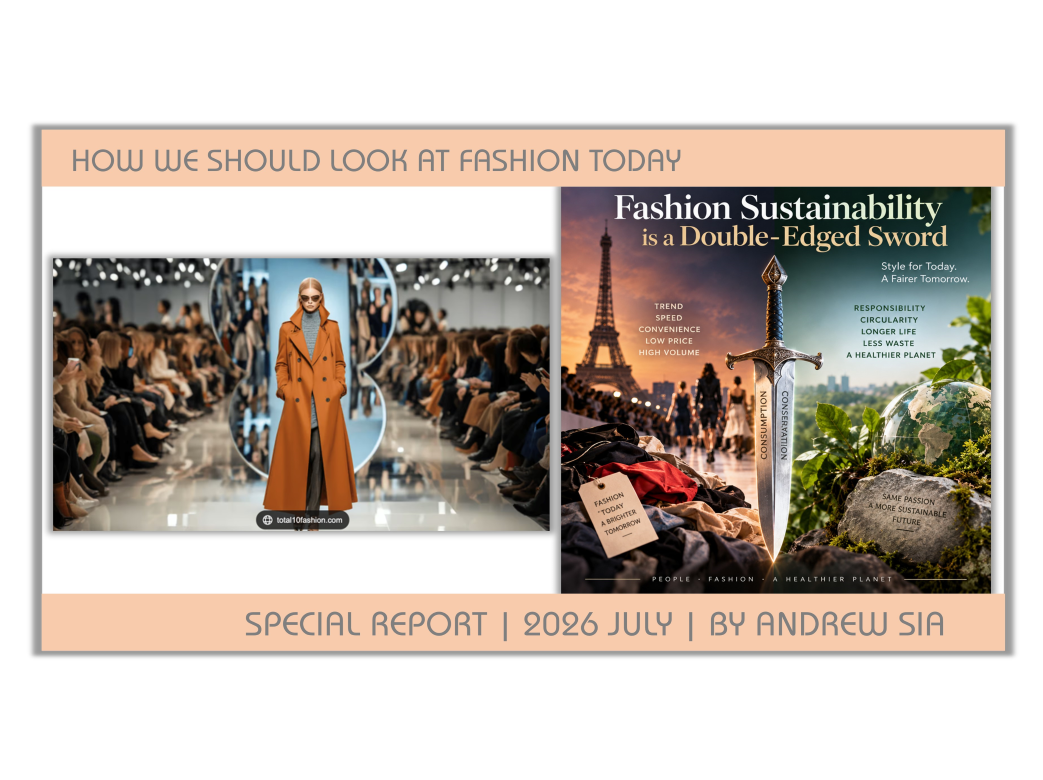
This piece has actually another title known as “Fashion Sustainability Is a Double-Edged Sword” and when I was preparing it, I have in front of me several forces colliding at the same time: sustainability, climate change regulation, affordability, ultra-fast fashion, resale, climate volatility, and geopolitics. This piece can’t bring out any positive message as our fashion industry can’t solve sustainability. It is making us to think how to change our “old” fashion model to live up to our expectation and how the fashion world can be vibrant again.
With this opening, let’s examine what cards do we have in our hand.
Latest Scene at the Fashion World
In the recent Paris Fashion Week, record-breaking temperatures for France set scenes where models and editors wilted on the extravagant outdoor runway, and the latter fanning themselves furiously or shelter under handheld parasols that offer little cooling effect against the brutal 40° C heat.
It was less than a decade ago, ambitious promises made by fashion companies to improve their environmental footprint were at its peak. But in the years after the pandemic, efforts have been waned. With the new wave of “ultra-fast” fashion brands such as Shein, of which instant trends at rock-bottom prices disrupted the sustainability.
There are other changes, such as the Trump’s administration has scrapped the sustainable business incentives and many of the targets are being obsoleted. This had led to American companies, like Nike and Under Armour, who have ceased any public sustainability reporting.
In Europe, Burberry pushed its net zero target back by ten years to 2050. Although H&M and Kering have made some headways with targets by reducing more than a third from their 2022 baseline. Others are lagging.
EU have finally banned on destroying unsold clothing as its Ecodesign for Sustainable Products Regulation (ESPR) took place in July. It is part of the Green Deal of which large companies are no longer allowed to destroy unsold clothing, footwear, and certain fashion accessories.
We have to blame on the economy as there is a growing cost of living crisis in many countries. It is surrounded by a relentless consumer behavior and shopping appear to be surrounded by cheaper choices. Money is going for food and other electronic gadgets, and clothing is becoming less important.
We have found shopping malls are empty and many retailers are forced to close their doors. Larger companies may have built-in e-commerce. They may absorb the restructuring of the business by adding the AI-enabled demand by forecasting and more efficient inventory management. Some can consider resale and recycle channels for mass-market fashion. But this would need the total dedication which can be quite challenging.
Fashion shopping decisions are still made on convenience and price.
Traditional fast-fashion retailers such as Zara and H&M are facing stiff competition from Shein who has just been public listed in Hong Kong. With the ample funding it can ship more products from its manufacturers in China directly to consumers in the West. It is adding 10,000 new items to its site each day and its shipments are all done by air cargo. Sustainability and labor compliance doesn’t exist with Shein which is very unfortunate.
Global Trade’s Situation
The global trade wars have increased the complication and added the challenge to the supply chain. It is making the sourcing and the supply chains in a more dire situation. The more transparent route with the standardized digital and connected with a QR code or radio frequency identification is adding more invaluable information for sourcing. To verify the product’s origin, materials, recyclability can make it more accessible.
Many manufacturers have open additional factories in Indonesia, Vietnam, Thailand, Bangladesh, Pakistan, and India for to avoid of being hit by the trade war. But with the additional capacities, they found that it is difficult to be booked for the additional business. They would consider themselves lucky if they can still maintain their regular business level.
Not to forget the second-hand shopping platform like Vinted from Lithuania, is taking away the business from the fashion houses. But when we look at it from the sustainability perspective, Vinted’s C2C second-hand marketplace has grown into countries like Germany, Portugal, Spain, Latvia, Estonia, and Slovenia. It set the model of an ecosystem of vertically integrated shipping and payment structure. Its 2025 gross merchandise value reached €10.8 billion, up 47%, while its revenue reached €1.1 billion, up 38%.
Donated Clothing in Africa
Most clothing donated in wealthy Western nations is sold to textile brokers, bundled into bales and export to African countries as second-hand goods, rather than going directly to people in need.
This billion-dollar donations is supposed to help countries like Ghana and Kenya, but only a small fraction of donated clothes is given away. Ironically it is known as “dead white man’s clothes” in Ghana. It is becoming a massive network for local vendors and has completely destroyed its local tailoring. The domestic garment industry is being wiped out.
The fast-fashion clothing has flooded the market with unwearable items, up to 40% or more imported bales arrived stained, torn, or completely unsellable. The unsellable items are dumped in open landfills, burnt, and the washing are discharged into waterways and beaches releasing toxics and microplastics.
The donated clothing is piling up on West African beaches and dumps.
We have to learn more about sustainable disposal alternatives for our old clothes and follow the African countries on how to manage textile waste. This is another topic that we will have to explore.
Woes of the El Niño Effect
Unpredictable weather patterns have appeared around the world, and the El Niño effect is going to continue through 2027. This is not making the business easier. It is adding heat waves, wildfire risks, droughts, and agricultural stress. Disruptions are added to the trade corridors, energy transport routes, sea routes, and global economic activities.
The Wars
With the war still continuing in Iran which is well into its seven months, and the war in Ukraine and Russia has been started since 2022 and it has entered into its four and a half years. This is certainly not helping the business world.
Conclusion
If we look through the above, I regret to tell you that they are all bad news. I don’t like to leave the piece with all these negative thoughts. Instead, I would like to ask ourselves some questions:
Perhaps it is right to say fashion sustainability is a double-edged sword because there is no single winner. We want the fashion industry to produce less waste, use fewer resources, reduce pollution, and stop destroying those perfectly wearable clothing. At the same time to have to continue to serve our customers with affordable fashion, and total convenience for their selections and value for money.
Not to deny that the unpredictable weather, economic uncertainty, and geopolitical conflicts are making an already complicated industry even harder to navigate.
We are being put into a position that we have to rethink.
Our fashion industry will still have ultra-fast fashion, fast fashion, slow fashion, luxury fashion, and second-hand fashion. We have to learn about each model and combine the best of each with the elements of affordability, technology, social responsibility, profitability, and sustainability. With the assisting of the artificial intelligence as the tool, we can find the best solutions for the aforesaid.
We have to leave to the consumers to decide what product suits them. Hopefully we can find the other edge of the sword, and the more hopeful one for the industry to go forward.
Remember that the fashion industry is under tremendous pressure, but the pressure is also forcing it to reinvent itself. We may have seen a lot of disruptions along the way, but it can also become the beginning of reinvention. Our predecessors have come through the three different stages of industrial revolutions, and they have not meant to be easy. We are entering the fourth industrial revolution, we have to examine what tools we have in our hand, and I am sure that we will come out from it stronger and better.