
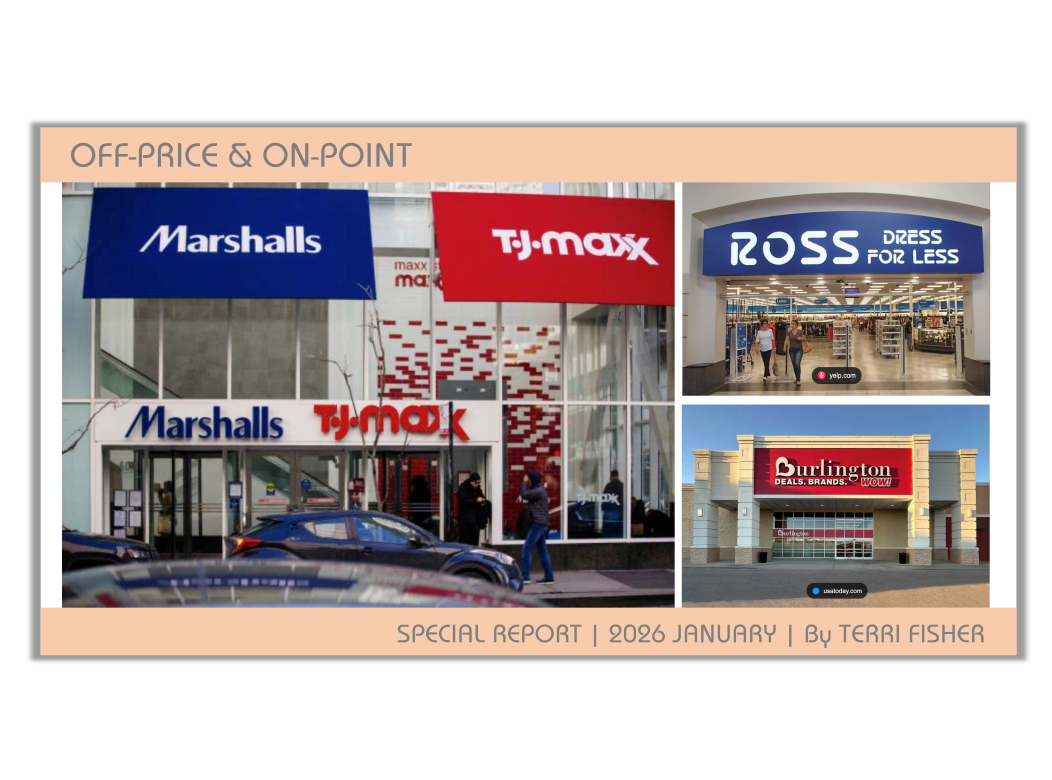
2026 JANUARY
OFF-PRICE
&
ON-POINT

Written by TERRI FISHER
Share this article !
From the Desk of the Publisher

This time the off-price retailing is really on demand as the world is heading for inflation because the war in Iran is still on. Consumers are watching their money which is understandable. Terri is writing about the key players — TJX Companies, Ross Stores, and Burlington Stores — all have been the lead players in this retail segment.
Her in-depth report has help us to understand this industry and can be useful for retailers in general to correct their courses to navigate in this volatile water.
You are welcome to contact our retail correspondent/specialist for more ideas.

OFF-PRICE and ON-POINT
In our current world of massive uncertainty, high costs for consumers on basics from food to gas, and a new world of wars and political divisiveness, retail has not been strong, and many retailers will fail or have already failed. One sector stands out among the rest: off-price retailers. They are perfectly positioned to save consumers money and help to ease their economic woes. Let’s take a closer look at these “winners” and why they are succeeding in a very tough environment.
The off-price retail sector—led by TJX Companies, Ross Stores, and Burlington Stores—has emerged as one of the most resilient and fastest-growing segments in modern retail. While traditional department stores and even some specialty retailers have struggled with shifting consumer behavior, inflationary pressure, and e-commerce disruption, off-price chains have thrived by delivering value, brand-name merchandise, and a “treasure hunt” shopping experience.
This article explores in depth the current success of these three industry leaders, examining their revenues, profits, store counts, leadership, and long-term growth strategies, as well as the broader structural advantages driving the off-price model.
The Rise of Off-Price Retail
Off-price retail refers to stores that sell branded apparel, home goods, and accessories at significant discounts—often 20% to 60% below traditional retail prices. These goods typically come from excess inventory, canceled orders, or specially produced merchandise.
The sector has seen sustained growth, with the global off-price market projected to grow at a compound annual rate of roughly 8.7% through 2032.
Several structural forces explain this momentum:
- Consumer value orientation amid inflation and economic uncertainty
- Inventory inefficiencies in full-price retail creating supply for off-price buyers
- Flexible merchandising models that allow rapid adaptation
- Broad demographic appeal, from low-income shoppers to increasingly affluent consumers
Within this context, TJX, Ross, and Burlington dominate the U.S. market and increasingly gain share from department stores and other retailers.

TJX Companies: Scale, Consistency, and Global Leadership
Financial Performance
TJX Companies is the clear market leader in off-price retail. Its scale dwarfs competitors, and its performance continues to set industry benchmarks.
- Annual revenue (2026): ~$60.4 billion
- Q4 FY2026 revenue: $17.7 billion (+9% YoY)
- Q4 net income: $1.8 billion
- Operating margin: ~13%+ with expansion trends
TJX’s consistent revenue growth—rising from ~$54 billion in 2024 to over $60 billion in 2026—demonstrates its ability to scale while maintaining profitability.
Store Footprint
- Total stores: Over 5,200 globally
- Long-term potential: Up to ~7,000 stores globally (planned expansion)
TJX operates multiple banners including T.J. Maxx, Marshalls, and HomeGoods, giving it diversification across apparel and home categories.
Growth Strategy
TJX’s success stems from:
- Massive buying power due to scale
- Global sourcing network
- Flexible inventory model allowing opportunistic purchasing
- International expansion in Europe and Canada
Its ability to quickly acquire excess inventory from brands and manufacturers gives it a consistent pipeline of discounted merchandise.
Leadership
TJX has long been known for disciplined leadership focused on execution and cost control. Its management emphasizes conservative guidance and operational consistency, which has helped build investor confidence over decades.
Why TJX Wins
TJX’s primary advantage is scale. With far more stores and higher revenues than competitors, it can negotiate better deals and maintain stronger margins.

Ross Stores: Operational Discipline and U.S. Growth Engine
Financial Performance
Ross Stores is the second-largest off-price retailer in the U.S., known for strong margins and disciplined operations.
Key figures include:
- Q4 2025 revenue: $6.6 billion (+12% YoY)
- Q4 net income: $646 million
- Annual revenue growth: ~7.7% in fiscal 2025
Ross has consistently delivered strong comparable-store sales growth, often outperforming expectations.
Store Footprint
- Current stores: ~1,800+ locations
- Long-term target:
- 2,900 Ross Dress for Less stores
- 700 dd’s Discounts stores
Growth Strategy
Ross’s approach differs slightly from TJX:
- Focus on U.S. market only (no international operations)
- Highly efficient store model with lower costs
- Limited e-commerce presence, emphasizing in-store traffic
The company plans to open around 85 new stores annually, reflecting steady expansion.
Leadership
CEO James Conroy has emphasized disciplined growth and operational efficiency. Ross is known for tight cost control, which helps maintain strong profitability even during economic volatility.
Why Ross Succeeds
Ross excels in execution:
- Lean operations
- Strong inventory turnover
- Consistent same-store sales growth
It has built a reputation for reliability rather than aggressive innovation, which has proven highly effective in the off-price model.

Burlington Stores: High-Growth Challenger
Financial Performance
Burlington Stores is the third-largest player but has recently emerged as one of the fastestgrowing.
- Annual revenue (2026): ~$11.6 billion
- FY2025 sales: ~$11.5 billion (+9%)
- Net income: ~$610 million (+21%)
- Q4 revenue growth: ~11% YoY
Burlington’s profit growth has been particularly strong, with margin improvements driven by operational efficiency.
Store Footprint
- Current stores: ~1,100+ locations
- Recent expansion: Over 100 new stores annually
Growth Strategy
Burlington is aggressively expanding:
- Opening ~100–110 new stores per year
- Taking over leases from bankrupt retailers
- Investing in supply chain and distribution improvements
Its smaller store format and sharper merchandising focus have helped it improve returns.
Leadership
CEO Michael O’Sullivan has led a transformation focused on:
- Simplifying the business model
- Improving margins
- Accelerating store growth
Under his leadership, Burlington has shifted from a coat-centric identity to a broader off-price retailer.
Why Burlington Is Gaining Ground
Burlington’s growth is driven by:
- Faster store expansion than peers
- Margin improvement initiatives
- Strong earnings growth trajectory
While smaller than TJX and Ross, it is closing the gap in performance metrics.
Comparative Overview
Metric TJX Companies Ross Stores Burlington Stores
Revenue ~$60B ~$20B+ (est.) ~$11.6B
Store Count ~5,200+ ~1,800+ ~1,100+
Growth Focus Global expansion U.S. expansion Aggressive store growth
Profitability High, stable High, efficient Improving rapidly
Leadership Style Scaled discipline Operational efficiency Transformation-driven
TJX dominates in scale, Ross in operational efficiency, and Burlington in growth momentum.

Why Off-Price Retail Is Winning
1. Value Proposition in Inflationary Times
Consumers increasingly seek value, especially during periods of economic pressure. Off-price retailers benefit directly from this shift, attracting both lower-income shoppers and higher income bargain hunters.
2. Supply Chain Advantage
Traditional retailers often overproduce or misjudge demand, creating excess inventory. Off-price retailers capitalize on this inefficiency by purchasing goods at steep discounts.
3. “Treasure Hunt” Experience
Unlike e-commerce, off-price stores offer a constantly changing assortment, encouraging frequent visits and impulse purchases.
4. Limited E-Commerce Exposure
While many retailers struggle with online competition, off-price chains rely heavily on physical stores, where their model works best.
5. Market Share Gains
Off-price retailers continue to take share from department stores and mid-tier apparel chains, as evidenced by their consistent revenue growth and expansion plans.
Future Outlook and Growth Potential
The outlook for TJX, Ross, and Burlington remains strong.
Expansion Plans
- TJX: Thousands of additional global stores planned
- Ross: Long-term U.S. store potential exceeding 3,500 locations
- Burlington: Continued rapid expansion with 100+ stores annually
Profit Growth
All three companies are expected to continue:
- Expanding margins
- Growing earnings per share
- Increasing comparable store sales
Industry Growth
The off-price sector is expected to nearly double in size globally by 2032, reinforcing long-term tailwinds.
Risks and Challenges
Despite strong performance, the sector faces risks:
- Dependence on excess inventory supply
- Competition among off-price players
- Macroeconomic volatility affecting consumer spending
- Tariffs and sourcing costs
However, these risks are mitigated by the flexibility of the off-price model.
Risks and Challenges
Despite strong performance, the sector faces risks:
- Dependence on excess inventory supply
- Competition among off-price players
- Macroeconomic volatility affecting consumer spending
- Tariffs and sourcing costs
However, these risks are mitigated by the flexibility of the off-price model.
Conclusion
The success of TJX Companies, Ross Stores, and Burlington Stores highlights a fundamental shift in retail. As consumers prioritize value and retailers grapple with inventory challenges, off-price chains are uniquely positioned to thrive.
TJX leads with unmatched scale and global reach. Ross excels through disciplined execution and operational efficiency. Burlington, meanwhile, represents the high-growth challenger, rapidly expanding and improving profitability.
Together, these companies demonstrate that off-price retail is not just surviving—it is reshaping the future of the retail industry.
Thank you for your time to learn about some good news for a change! Please let me know if you want me to dig into any specific retailers in the future.

Terri Fisher
Retail Correspondent
terri@iappareljournal.com