
2026 JANUARY ISSUE
THE GLOBAL RACE
FOR
FUSION ENERGY

Written by ANDREW SIA
Share this article !
From the Desk of the Publisher

With global warming intensifying and the transition from fossil fuels to renewable energy is far slower than the world’s need. Fusion energy appears at exactly the right moment. If we succeed, fusion can provide the clean, abundant, and reliable power that our modern world, especially our demanding universe of AI data centers urgently requires.
We will soon find fusion energy as the center for the energy conversation as it is the solution for us during this crucial moment. The world needs a new clean baseload source.

Introduction
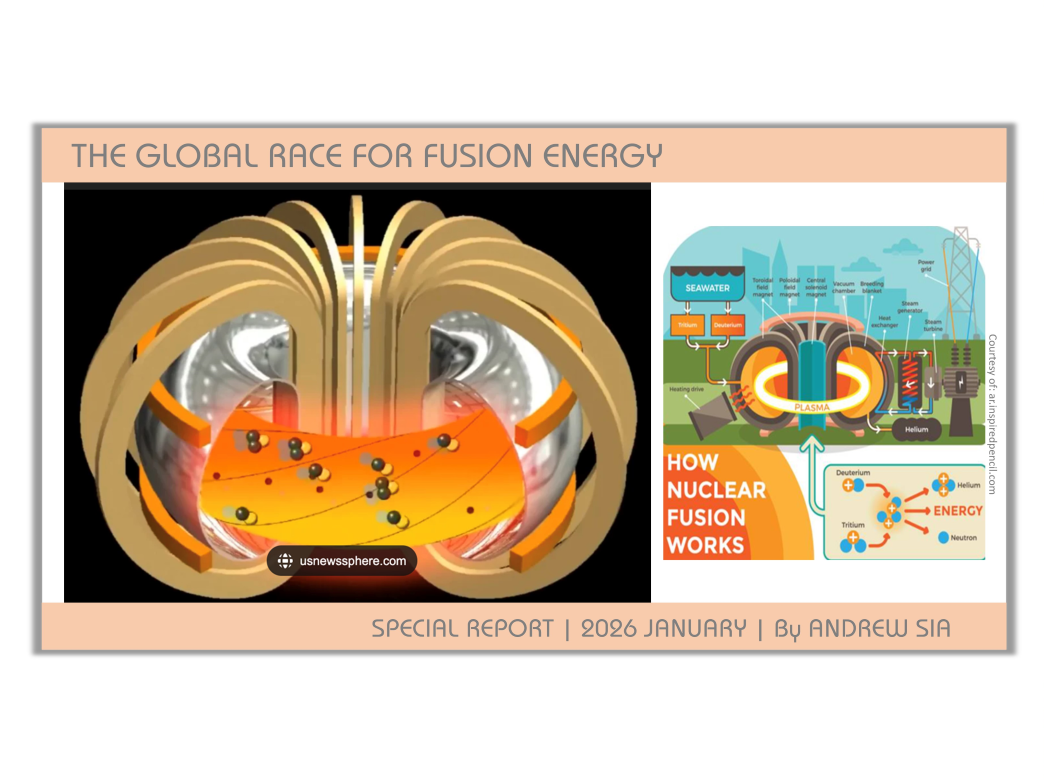
Fusion energy is a potential method of electric power generation that harnesses the heat released by nuclear fusion reactions where two light atomic nuclear combine to form a heavier nucleus, releasing energy in the process. This process occurs naturally in stars, including our Sun, and scientists are working to replicate it on Earth using devices that generate and sustain plasmas.
Currently, significant projects like the International Thermonuclear Experimental Reactor (ITER) are underway to advance fusion energy research, making it a strategic priority for future energy solutions. Fusion energy promises a cleaner and virtually limitless power source, distinguishing it from fission energy, which is currently used in nuclear power plants.
Transforming Fusion into the Future of Energy
Fusion energy represents one of the greatest technological breakthroughs of this century. The United States is counting on private industry and American innovation to lead the next leap forward. China, however, has made fusion a national priority. Recently a Shanghai-based start-up achieved an engineering milestone comparable to the progress made by America’s most heavily funded fusion company — Commonwealth Fusion Systems (CFS) — but in far less time.
Over the summer, the Chinese government and private sector invested $2.1 billion into a new state-owned fusion enterprise for an amount two and a half times larger than the U.S. Department of Energy’s annual fusion budget.
CFS announced that by 2027, its experimental device in Massachusetts aims to achieve a historical milestone: producing more energy than it consumes, enough to power data centers, steel mills, and other industrial systems.
China is pursuing similar ambitions. Its leading plasma-physics laboratory is building a new tokamak known as BESR, with the goal of reaching net-energy milestones within the next few years. China’s commitment comes from the highest levels of leadership. Its Five-Year Plan for 2026-2030 calls for “extraordinary measures” to secure breakthrough in fusion energy and other strategic technologies.
China’s state-owned nuclear corporations are drafting detailed fusion research proposals, describing the field as “the race of future scientific and technological competition among great powers.”
Only two decades ago, China was a newcomer in fusion research. It advanced rapidly by collaborating with international partners, working closely with France to develop its most modern tokamak, and becoming a major contributor to the 33-nation ITER fusion project. Through the past decade, American and Chinese scientists conducted joint experiments and praised the friendship and cooperation in plasma physics.
Now, China is building cutting-edge facilities of its own. The Chinese Academy of Sciences’ Institute of Plasma Physics is constructing both the BESR tokamak and a nearby research complex where scientists will develop and test components capable of operating under the extreme conditions inside a fusion reactor.
China has learned extensively from its participation in ITER and is now applying that knowledge toward its own advancements. Even if the core technology succeeds, fusion reactors will not power the world until companies develop affordable, scalable industrial designs.
China’s long-standing strengths in engineering and construction give it a distinctive advantage. While the U.S. often focuses first on creating a viable scientific pathway, China tends to engineer and scale solutions simultaneously, accelerating the transition from research to deployment.
Closing Remark
The world is urgently trying to slow global warming by reducing dependence on fossil fuels and shifting toward renewable energy sources. Yet this transition is slow, difficult, and uneven. Solar, wind, hydropower, and geothermal, are growing, but they still cannot provide the constant, large-scale, 24/7 power that our modern societies, especially the data-driven economies require.
This is why fusion energy arrives at a critical moment in history, and if it is successful, it can offer:
Carbon-free electricity,
limitless fuel from seawater,
limitless fuel with no meltdown risk,
no long-term nuclear waste, and
continuous, stable baseload power.
Fusion can fill the enormous gap between our climate goals and our technological demands, especially for AI, data centers, electrification, and industrial growth consume more energy than ever before.
One day, fusion energy may be the answer to the world’s insatiable appetite for energy, especially the immerse power needed to operate the AI data centers of tomorrow.