
2026 JULY ISSUE
METAVERSE
A TRILOGY OF
TRANSFORMATION

Written by ANDREW SIA
Share this article !
Prologue
One night, as my mind wandered through the Metaverse, I began reflecting on the extraordinary journey of human civilization and how we have arrived at this remarkable moment in history.
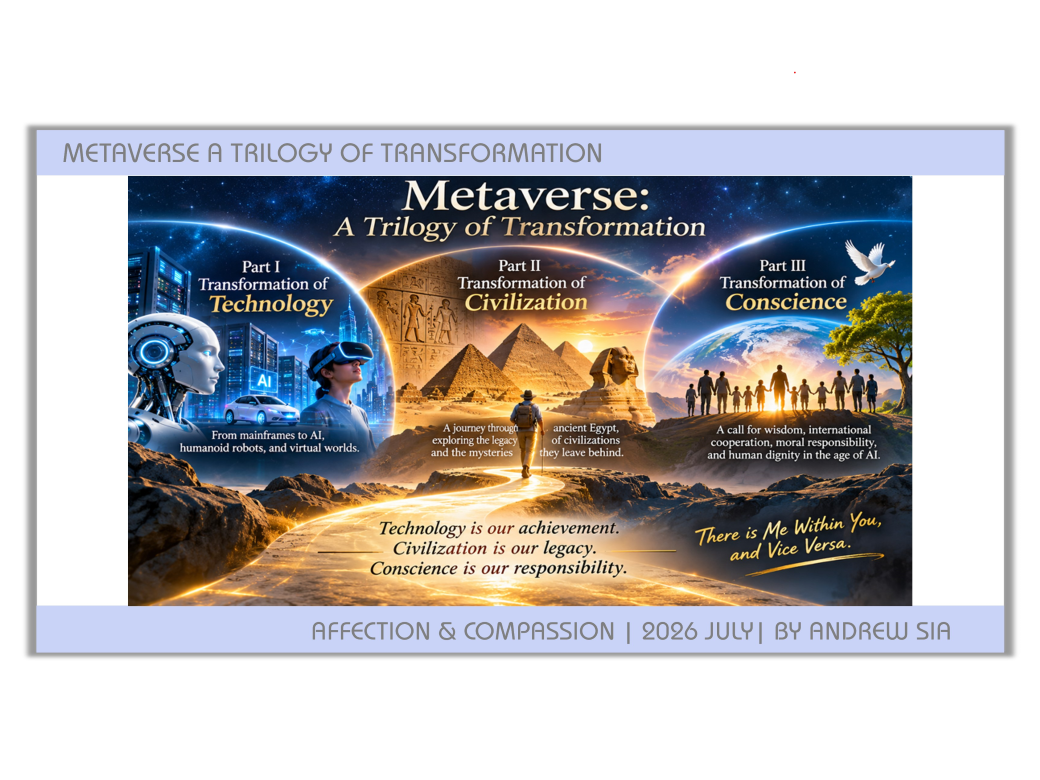
These reflections inspired me to write Metaverse: A Trilogy of Transformation, a journey through the past, present, and future of humanity. I have divided this journey into three parts, each exploring a different dimension of the transformations taking place in our world.
Part 1 – Transformation of Technology
Metaverse Take 1
From mainframe computers to AI, humanoid robots, and virtual worlds.
Central question: As technology becomes more human, are we becoming less human?
Part 2 – Transformation of Civilization
Metaverse Take 2
A journey through ancient Egypt, exploring the legacy of civilizations and the mysteries they leave behind.
Central question: What will our civilization leave for future generations?
Part 3 – Transformation of Conscience
Rhapsody in Metaverse
A call for wisdom, international cooperation, moral responsibility, and human dignity in the age of AI.
Central question: Can humanity develop the wisdom to match the intelligence it creates?
Metaverse Take 1 – Transformation of Technology

It’s a game and it is so surreal.
Our generation went through the age of mainframe computer, when those enormous machines required elaborate cooling systems, sometimes using chilled water to keep their temperature down.
Then we had the personal computer, connected through the internet.
The mobile phone took us by storm, and eventually we trusted so much our data to the cloud.
Now, be ready for something that may blow our minds.
It’s the Metaverse, and in this arena, almost everything can become virtual.
You can purchase things in the Metaverse.
You can meet people and even go on a virtual date.
Even human intimacy may someday become something abstract.
Electric Vehicles are increasingly taking over automobiles powered by the traditional internal-combustion engine.
We begin to hear about autopilot and robotaxis. Could the cybercab someday take over the place of our familiar yellow cab.
At first, I thought that robot can be the ultimate technology achievement.
And Artificial Intelligence is offering solutions you would never have thought possible.
Lately, however I have seen humanoid robots dancing, performing complicated movements, and even running a half-marathon.
Then came the enormous data centers, filled with the sophisticate chips and servers, draining electricity as though there were no tomorrow.
Tech companies are racing to secure chips, electricity, land, water, and locations for their next data centers.
Governments welcome the investments, utilities struggle to provide power, communities begin to ask what these enormous developments would mean to them.
We talk about another bubble, but nobody seems to be listening.
Sometimes I ask myself whether this world is real anymore.
We started by teaching machines how to calculate, learn to listen, and respond intelligently.
Now we are teaching them how to work, dance, run, and even behave like us.
Behind much of this are algorithms—quietly calculating, sorting, predicting, recommending, and increasingly influencing the decisions we make.
We begin to wonder whether technology has crossed the line and become more human.
Perhaps we should ask ourselves another question: As technology becomes more human, are we becoming less human?
“Stop the world, I want to get off!”
Metaverse Take 2 – Transformation of Civilization

After waking up in the middle of the night my mind was drifting.
I’m walking down the memory lane, and I’m still thinking about the piece I wrote earlier—Metaverse Take 1—and cannot get off that trailer.
It is so surreal, and I begin to let myself enter the time tunnel. This time I am going back through history.
My mind enters ancient Egyptian times, and suddenly, physical and digital worlds are indistinguishable.
I’m standing before pyramid after pyramid in the Giza Plateau as they scatter around the desert.
The Great Pyramid of Giza is 481 feet tall, which is nearly as tall as a forty-floor building.
It was built for Khufu in the Old Kingdom, around 2,600 BC.
I begin to wonder how they could have moved 2.3 million blocks, each weighing 1.5 tons, to construct this magnificent structure more than 4,600 years ago.
Pyramid-like monumental structures arose in different civilizations.
At this moment my twenty-first-century mind can’t help but make an outrageous comparison.
I can only think their purpose is to transmit information and energy, doing some processing collectively.
I even dare to connect them to the AI data centers that we are building, and the pyramids could have been ancient data centers.
Suddenly, this transformation from the ancient world to our modern time starts to make sense.
I begin to investigate what the historians told us about the artifacts they found inside the pyramids.
Could the pyramid be a “machine” used to preserve knowledge and information, waiting for the next civilization to figure out what it was meant for?
It can be something we have been using in our time to transform information into intelligence.
But it would leave physical traces that human civilization may struggle to understand, similar to what is happening to us now.
From the drawings inside the pyramids, we question the whereabouts of the pharaohs.
In the Valley of the Kings, we have found royal tombs, and mummies of Ramesses II and Tutankhamun.
Pharaohs are gone, together with the structure of their society.
Also, their language, religion, technology and methods….
What they have left behind is something remarkably parallel with our civilization.
For the past 500 years we have archaeologists, historians, scientists and researchers trying to decipher the artifacts left behind.
Today it’s still a mystery, and we are unable to understand what are in the massive “data centers” they left in the desert.
We found that in prehistoric Egypt, thousands of years before the pharaohs, there were farming communities who could produce pottery, ritual practices, and social organization.
In Egyptian times, we find drawings with remarkably consistent images; humans with animal heads, gods with distinctive crowns and symbols, winged beings, boats, solar imagery, strange creatures, and geometric motifs.
They were perhaps used to symbolize the religion systems they developed.
It was a civilization that used objects to represent human beings, animals, symbols, and celestial imagery.
Or could they be those graffiti littering on the walls?
We still don’t have the key to decode all these findings, which have largely disappeared together with the civilization that disappeared with it.
The Great Pyramid and the Sphinx are perfect examples that represent the ancient Egyptian times.
It remains a total mystery as to how they were constructed, their symbolism, chronology and historical content.
Although the Rosetta Stone, a broken fragment of a larger inscribed stone slab, inscribed in 196 BC could have left behind some ideas.
Earlier on in our Take 1, we talked about “transformation of technology.”
Now we are talking about “transformation of civilization.”
I begin to ask myself what we can leave something behind that may benefit our future civilization and not like all the mysteries that we are facing.
We want to do the transformation with conscience.
The Egyptians may have looked at the universe and tried to present through their gods, animals, humans, stars, symbols, death and reincarnation.
They left architecture, writing, mathematics, art, religious texts and extraordinary physical monuments.
Our civilization may leave data centers, satellites, semiconductor labs, nuclear facilities, artificial intelligence, and digital archives.
As our technology becomes more powerful, we must also become more grateful.
This danger doesn’t come from the technologies itself but from how human beings choose to use it.
Intelligence placed in the wrong hands, or used without wisdom, restraint and conscience, can damage us.
The Egyptians built monuments they expected to endure.
We are building intelligence we expect to evolve.
With incomplete knowledge we have passed through the last 5000 years through a chain of transformations.
Each generation inherits something from the previous one.
The last 500 years have been the fastest as we have gone through the First Industrial Revolution and we are now entering into the Fourth Industrial Generation which is AI.
Our data centers are huge, expensive, power-hungry and need a lot of water to cool them.
We need world leaders with humility to protect our humanity and leave behind something that can benefit generations to come.
Perhaps one day, thousands of years from now, another civilization will discover the remains of our enormous data centers and wonder what strange gods we worshipped.
They may discover that we possessed extraordinary intelligence yet still struggle to understand whether we possessed wisdom.
The Egyptians left us pyramids of stone. We are leaving behind pyramids of information.
But the greatest legacy of civilization should not be the monuments we build or the machines we invent. It should be the humanity we preserve.
After all, what good is artificial intelligence if we allow human wisdom to disappear?
Rhapsody in Metaverse – Transformation of Conscience

In my Metaverse, I turn back and I can see the Egyptian Empire.
I see the row of the three pyramids, the Great Pyramid of Khufu, the Pyramid of Khafre, and the Pyramid of Menkaure on the Giza Desert.
They were built as royal monuments, required extraordinary intelligence, organization and determination.
They are in visual resemblance with the three stars of Orion’s Belt.
Coming back how could they move 2.3 million blocks of limestone, each weight roughly 1.5 tons is still a mystery.
But we respect the human intelligence the Egyptians have more than 4,600 years ago.
It is not only meant for the burial of the pharaohs, and its purpose is beyond of imagination.
It could be their architectural knowledge, their organizing skill, their persistence, their willpower are above all.
We have to respect the Egyptians when we are standing on the Giza Desert as it is so real and not a fantasy.
It is the Data Center of the third kind.
Then I turn myself and look forward:
In this Metaverse I want to embrace Artificial Intelligence.
But above all, I want t to embrace our mankind.
We need to set international rules how far we should push the boundary of AI.
Respect it with morale and human dignity and don’t allow human greed to take over our conscience.
Remember that it is us, the human, who created AI, and don’t let it overrule us.
Use it wisely in our Industrial Revolution 4, and let AI walk besides us through automobile, fashion and textiles, logistics, energy, agricultural, manufacturing, education, and healthcare-helping us build a more— productive, compassionate, and sustainable civilization.
Artificial intelligence can assist with knowledge, analysis, creativity, and decision making.
Make sure human leads roles for the values, judgements, and consequences involved.
Let artificial intelligence walk beside us as we travel into the future.
Let it help us discover, create, heal, and build a better civilization.
But never surrender to it the conscience that belongs to humanity.
One day, when our journey on Earth comes to an end, I hope we will leave behind more than technological monuments and unanswered riddles.
Let us leave behind wisdom, compassion, and a world where future generations can live with dignity.
And through this journey I took, I have become even more convinced of something I wish to share with everyone:
“There is Me Within You, and You Within Me.”
We may come from different countries, cultures, and generations, but our future belongs to one humanity.
Kudos to my friends out there!
Epilogue
Rhapsody in Metaverse, the closing chapter of this trilogy, was inspired by Queen’s Bohemian Rhapsody, whose haunting opening questions whether life is real or merely a fantasy.
These questions seem particularly relevant today, as the Metaverse, artificial intelligence, humanoid robots, autonomous vehicles, algorithms, and enormous data centers are transforming our world and challenging our understanding of the boundaries between what is real and what is virtual.
Where will all these transformations eventually lead us? Will they make our world a better place, or will they create challenges that humanity is not yet prepared to face?
I have no answers, but I know that:
Technology is our achievement. Civilization is our legacy. Conscience is our responsibility.
Metaverse: A Trilogy of Transformation has taken us on quite a journey, from the ancient pyramids to artificial intelligence, and finally back to the most important subject of all: humanity.
The trilogy began with “Stop the world, I want to get off!” and ended with “Kudos to my friends out there!”
What began as a feeling of bewilderment at the speed of technological change has become a reflection on our shared responsibility for the future.
And so, I would like to conclude this journey with one final thought:
“Let us make a better place for those who come after us!”
Grand Finale
I want to quote what a young girl, Vincy, at the age of 24 quoted after the reading of this Metaverse Trilogy. Quoted:
“Agreed the importance of humanity and consciences in not letting our new inventions of technology overtake the value of being mankind.
Love the comparison of the 21st century data center with the pyramids of the ancient times. While I have always been fascinated with the wisdom in expressions, creativities, arts and cultures show in artifacts of the ancient times, it makes me wonder if the modern world today is lack of demonstrating these disciplines, where the mainstream society has all the focuses on building robots to replace all “hard works” of mankind.
If the transformation is evolutionary to humanization or if it is gradually demolishing the intellectual of us as being a human.
While reliance on technology and artificial intelligence seems to be unstoppable, and undeniable to adapt to “survive” in this society, all these make me wonder about the purpose of living when everything could be replaced? What is good without hardship?”
My response to a voice from the Next Generation — What is good without hardship?
The greatest achievement of technology should not be the elimination of everything that makes us human. Rather, it should be the liberation of humanity to pursue greater wisdom, creativity, compassion, and purpose.
We must not confuse a life made easier by technology with a life made more meaningful by it.
The future belongs not merely to those who build intelligent machines, but to those who possess the wisdom and conscience to decide how those machines should serve humanity.
My first encounter with a humanoid in 2023 and it was trying to intimidate me by growling at me. I told it to “Shut up.”