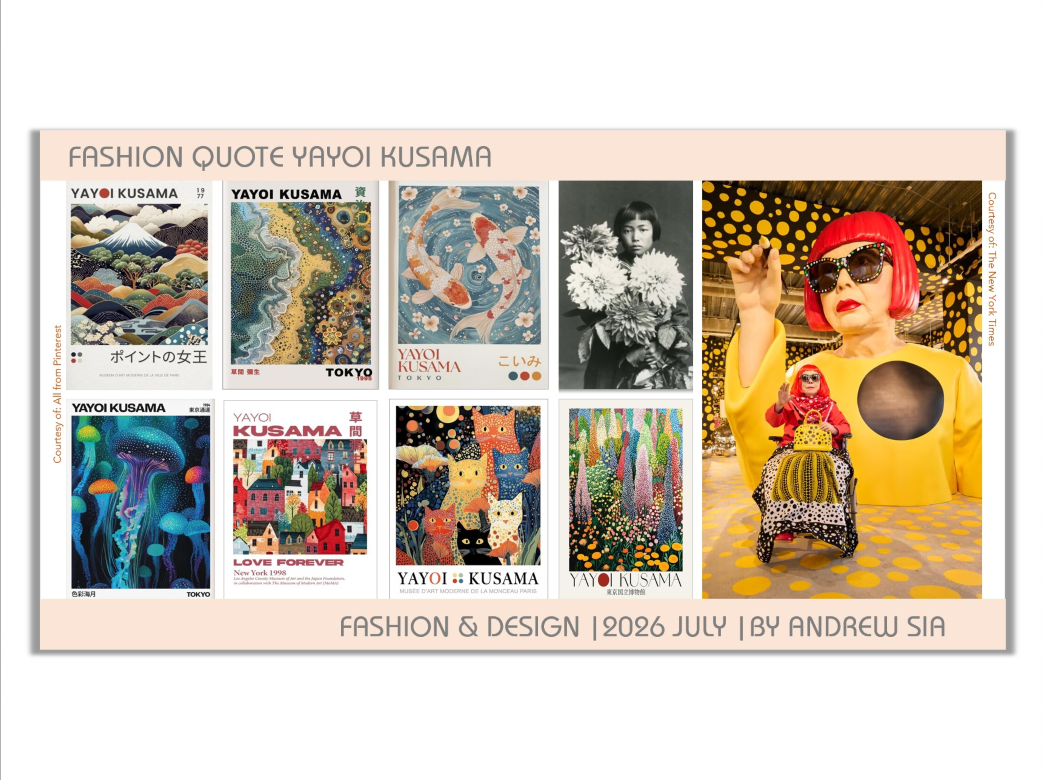
“My love for humanity and for the world has always been the driving force and energy behind all that I do.
- Yayoi Kusama
Written by Andrew Sia
Share this article!
Facebook
Twitter
LinkedIn
From the Desk of the Publisher
I have no knowledge of this designer who has so many talents, and the more I read about Yayoi Kusame, I become more impressive. It all began in 1965 when she created her first Infinity Mirror Room in New York City. It was driven by her making of the large numbers of repeated soft sculpture by hand and the process was exhaustive. She created the mirrors to give her the solution, and instead of making thousands upon thousands of objects, she could now make a limited number and allow their reflections to multiply into something seemingly forever. This is an artistic breakthrough.
She created more than twenty distinct Infinitely Mirror Rooms over her career. Some belong to major museum collections, and others have travel internationally in exhibitions. With her years of experiences, she developed into an artistic language that the art world knows, which is involving infinity, repetition, self-obliteration, life, death, and our place within the universe.
When someone enters the Infinity Mirror Room, for that moment the boundaries of the room disappear. You see yourself, but you also see yourself becoming almost insignificant within something apparently in endless way.
Afterall, Yayoi Kusama could not make infinity, but within a few mirrors, some lights, and an extraordinary imagination, she taught us how infinity might feel.
Introduction
Yayoi Kusama born March 22, 1929, in Matsumoto, Japan, and passed away on August 14, 2026, at the age of 98.
She was a Japanese artist who self-described herself as an “obsessional artist.” She was known for her extensive use of polka dots and for her “Infinity Room” installation. She worked with paintings, sculpture, performance art, and installations in a variety of styles, including Pop Art and Minimalism.
It was most impressed when someone described Kusama as: “an artist who captured infinity,” when she launched the “Infinity Room” in a New York gallery in 1965. It was a visual effect that everyone was keen on.
Her Childhood
Courtesy of: The New York Times
Yayoi Kusama was born in Matsumoto, Nagano on March 22, 1929, into a family who owned a nursery for plants and seeds. She started painting as a child, and at that time she began experiencing hallucinations that often-involved fields of dots. Eventually this set the theme of dots that was shown throughout her career. She had very little formal training, and only study briefly in 1948-1949 at the Kyoto City Specialist School of Arts where she received her training in a Japanese painting style known as “nihonga.” It is a Japanese style of painting that typically uses mineral pigments, and occasionally ink, together with other organic pigments on silk or paper. It is different from the Western-style painting. This term can also use to describe pictures in a Japanese style.
With family conflicts and a relationship between her parents, her childhood was traumatic, including her hallucinations, this could have late developed her original artistic style.
When she was 13, it was the time of the Second Sino-Japanese War (1937-1945), she worked in a military factory where her task was making parachutes for the Imperial Japanese Army. She spent the time in closed darkness and could hear the air raid sirens and the US B-29s flying overhead during the day. Her childhood was affected by the war.
Her later study of nihonga painting led her to become interest in the European and American avant-garde, and she staged several solo exhibitions of her paintings in Matsumoto and Tokyo in the 1950s.
Early Years in Japan
Kusama was living between Tokyo and Paris, but when she was 27 years old, she left Japan for the United States. She stated that she began to consider Japanese society too small and too feudalistic, and even scornful of women. And before leaving for the United States, she destroyed many of her early work.
Courtesy of: Pinterest | Yayoi Kusama 1958
First, she stayed in Seattle for one year before moving to New York City in 1958. She was using Georgia O’Keeffe’s advice, and the majority collections were created. Her first exhibition that was showing Infinity Networks and sculptures earned a great success in the following year at the Brata Gallery. She quickly earned her reputation as a leader in the avant-garda movement and received praise for her work from the anarchist art critic Herbert Read.
In 1961, she became a close friend with a sculptor, Eva Hesse, who was known for working in materials like latex, fiberglass, and plastics. Also with another American artist, Donald Judd, known for minimalism. In his work he used materials like metals, industrial plywood, concrete, and color-impregnated plexiglass. Kusama moved in with them and began to create soft sculpture for items of her likings. She posted herself regularly with her work and appeared in public wearing her signature bob wigs and colorful, avant-garde fashions.
She continued to be enormously productive that she was hospitalized from overwork, and because she wasn’t able to make the kind of money she believed she deserved, out of her frustration she attempted suicide.
During the 1960s, she organized outlandish happenings in spots like the Central Park and the Brooklyn Bridge, often involving nudity and designed to protest the Vietnam War. Between 1967 and 1969, she focused on maximum publicity and usually involved performers who were instructed to embrace each other in the sculpture garden of the Museum of Modern Art. She would paint polka dots on her nude performers as in the “Grand Orgy to Awaken the Dead” at the MoMA.
Kusama had a leading role in New York in the Minimalism and Pop Art movements when she was living in New York City. What followed was more eccentric and weird which I would refrain from elaborating here.
Return to Japan: 1973-1977 | Courtesy of: All images from Pinterest
At first, her reception from the Japanese art world and press was unsympathetic. She was even called a “scandal queen.” Kusama became depressed and attempted another suicide. Eventually she took up a permanent residence in Seiwa Hospital, a psychiatric hospital in Shinjuku, Tokyo.
Her studio was a short distance from the hospital where she continued to work. Very often she would quote by saying, “if it was not for art, I would have killed myself a long time ago.”
But on the other side, she became an idol for the youth culture. Within Japan she is among the most culturally influential women in modern history.
Courtesy of: Pinterest | Yayoi Kusama 1977
Courtesy of: Pinterest | Yayoi Kusama 1958
Revival: 1980s to 2026
She continued her endeavors around the world with her polka dots, pumpkins, mirrors, flowers, and patterned fabrics from her hallucinations in her childhood. Her work was a display of repetitive patterns and her works on display showed that she immersed herself into her accumulations, obsessions, and repetitions. I see her as a tragic character.
But on the other side, she became an idol for the youth culture. Within Japan she is among the most culturally influential women in modern history.
Courtesy of: Pinterest | Yayoi Kusama 1984
Courtesy of: Pinterest | Yayoi Kusama 1984
Courtesy of: Pinterest | Yayoi Kusama
Her Work in Fashion
Courtesy of: Pinterest | Yayoi Kusama 1984
In 1986, Kusama established Kusama Fashion Company Ltd. and began selling avant-garde fashion in the “Kusama Corner” in Bloomingdale’s.
In 2009, she designed a handbag-shaped cell phone entitled Handbag for Space Travel.
In 2011, Kusama created artwork for six-limited-edition lip-glosses from Lancôme. That year she worked with Marc Jacobs and brought a line of Louis Vuitton products, including leather goods, ready-to-wear, accessories, shoes, watches, and jewelry. The products were released in 2012 at a SoHo pop-up
shop decorated with Kusama’s trademark tentacle-like protrusions and polka dots. She was invited again in 2023 for another set of products.
Courtesy of: ELLE | The Art of Fashion: Louis Vuitton’s
Conclusion
Globally, Kusama’s most iconic series is the Infinity Mirror Rooms which she introduced in 1965. It was in the 1990s she created a larger kaleidoscope environment that visitor entered one at a time. This becomes the “must visit” art-world experience, where the visitor would enter one at a time, after queuing of more than an hour for a minute. In this mirrored room, you see your own reflection splintered into endlessness. A selfie is usually taken for posting in the Instagram.
Yayoi Kusama has a museum, Yayoi Kusama Museum under her name in Tokyo. She began as an avant-garde rascal and became a pop icon finally.
She was born in a well-to-do family but wasn’t supportive to her during her childhood. In some circumstance, she was very much abused by her mother. Her desire to become an idol was discouraged and she had no choice but to move to the United States and started all by herself.
She turned her physical handicaps, hallucinations and dreams, into a positive drive for her multiple talents. We have to admire her courage.
Yayoi Kusama is an artist with many facets—sculpturer, painter, fashion designer, writer, poet, and many others. When I was trying to find one of her quotes to use in this writeup, it was very difficult. Instead, I have chosen the following knowing where she came through in the 90-odd years of her life on earth. I would like to remember her as the following:
“My love for humanity and for the world has always been the driving force and energy behind all that I do.”