
2026 JULY ISSUE
ENTERING THE AGE OF
ARTIFICIAL INTELLIGENCE
IN INDUSTRY 4.0

Written by ANDREW SIA
Share this article !
From the Desk of the Publisher

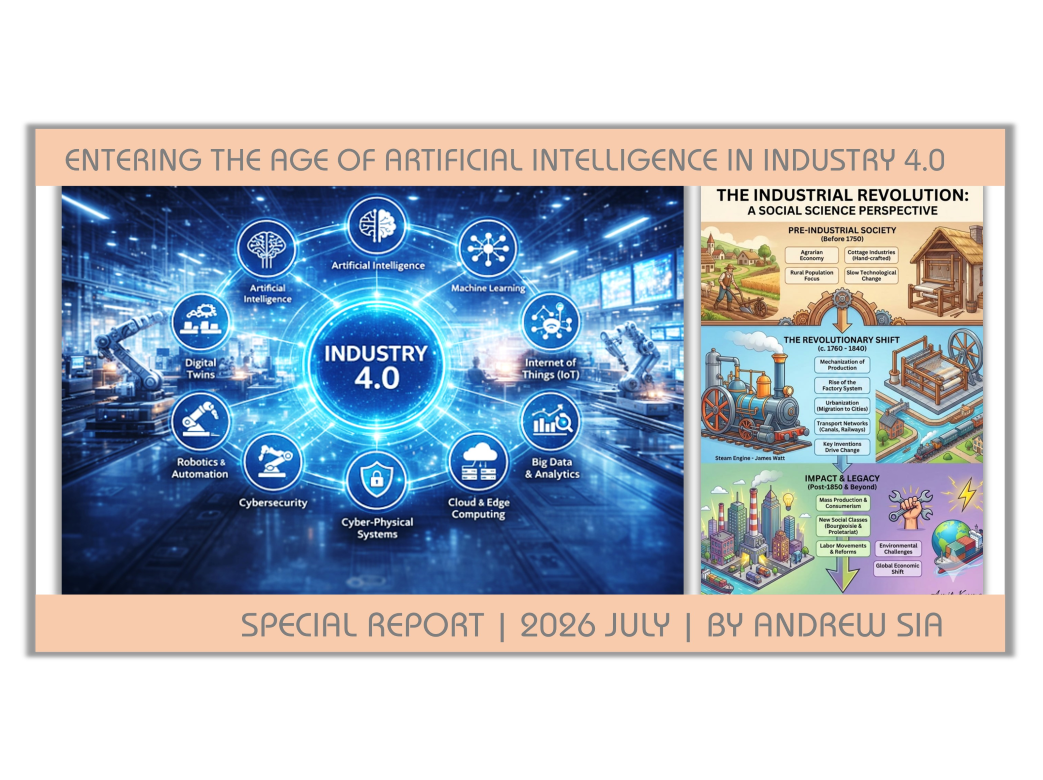
From 1760, when the First Industrial Revolution took place in England, we are now in our Fourth Industrial Revolution, which we call it Industry 4.0, and they have happened in the time span of 266 years to be exact.
We walk you through every industrial revolution and what it meant during the time.
We also brought out the four pillars of artificial intelligence, the comment as made by Pope Leo XIV which brought out Pope Leo XIII in the crossover of First Industrial Revolution and Second Industrial Revolution.
Finally, we discussed about China’s attitude of AI in relationship with its labor situation.
All these contents can alert us to observe the human dignity and to remind us in considering where the human being stands in this new revolution. This piece would perhaps leave us with a lot of thoughts.
Industrial 4.0 has brought up the challenge that every industrial revolution, and ultimately everyone has to answer to people whose lives it changes.

Introduction

The First Industrial Revolution took place from 1760 to 1840 and was originated in Great Britain. This marked the shift from agrarian and hand-crafted economies to mechanized, and factory-based manufacturing. This industrial revolution relied heavily on steam power and coal.
The Second Industrial Revolution, also known as the Technological Revolution, was a major historical period of rapid industrial development spanning from 1870 to 1914. It transformed the industry through mass production, electricity, and oil.
The Third Industrial Revolution is often known as the Digital Revolution, and it is a historical period that began in the latter half of the 20th century. It represented the transition from mechanic and analog electronic systems to digital electronics, computers, and the internet.
The Fourth Industrial Revolution is something I would refer to as Industry 4.0 which is the extension of the Third Industrial Revolution. We are experiencing it every day, and its magnitude is unknown. Worldwide economies are based on them, and programs and projects are based on them.
Algorithm is designed to solve a specific problem and also perform a computation. It is a highly precise instruction that takes an input of data or raw materials and processes it through a strict set of logical steps and reach an expected output.
Artificial Intelligence (AI) serves as the brain of Industry 4.0 by integrating machine learning, IoT (Internet of Things), and advance data analytics into cyber-physical systems. AI shifts manufacturing and industrial operations from reactive to predictive. It operates smart factories by automating decisions, optimizing resources, and drastically reducing equipment downtime.
Integrating AI into industrial processes help to transform workers’ roles and shift them into supervisory, analytical, and problem-solving capacities. Operators evolve into process analysts, creating cross-training in digital and system-thinking skills while AI handles routine, repetitive tasks and data analysis.
Despite its massive potential, organizations are finding hurdles when adopting AI in Industry 4.0 as system integration between the legacy machines and IT systems must be interconnected seamlessly for algorithms to read and write data. AI requires high-quality, continuous and organized data to operate. Employees must understand AI is designed to augment their jobs rather than replacing them.
This is no easy and that’s why we have decided to look deep into the transition from where we are, both in our way of thinking, and how we can trust AI and use it as a powerful tool to improve our human society and give consideration to all aspects.
The Four Pillars of the AI Revolution
Semiconductors – the Brain
This is the physical computing power that processes instructions. It is the physical brain, the hardware. Companies like TSMC, NVidia, and Intel design and manufacture the chips that power modern computing.
Internet of Things (IoT) – the Nervous System
This is the sensors and connected devices that sense, communicate and act. Billions of connected devices continuously collect information from homes, factories, hospitals, farms, and cities.

AI (Artificial Intelligence) – the Mind
It learns, interprets, reasons, predicts, and increasing make decisions. Artificial intelligence operates through the hardware put together by the brain—the semiconductors. Just as human mind cannot operate without a brain, AI analyzes the enormous volume of data produced by IoT devices and identifies patterns, makes predictions, and support decision-making.
Data Center s – the Heart and Memory
They house computing infrastructure, store enormous quantities of data and keep digital services running. Massive computing facilities store data and provide the processing power that AI systems require.
The central of this concept is like the following:
Semiconductors – give AI the power to compute.
Internet of Things – gives it the ability to sense and communicate.
Artificial Intelligent – gives it intelligence.
Data Centers – give it place to live, work, and remember.
And above all, we have to add humanity above the four pillars. I would like to look at the whole thing by adding the human being.
Human Being – Our soul and conscience as the whole
The Brain – Semiconductors
The Mind – Artificial Intelligence
The Nervous System – Internet of Things (IoT)
The Heart and Memory – Data Centers
We have to remember that technology can become more intelligent, more connected and enormously more powerful. But intelligence is not the same thing as wisdom. And most important that humanity must provide conscience, purpose with wisdom.
The important question for us at this time of the Industry 4.0 that it is not our achievement to build increasing intelligent machines. We have to put the benefit of humanity above all and make sure that this powerful tool is in the hand of the responsible person.
Pope Leo XIV’s Remark About AI
On May 25, Pope Leo XIV presented his first encyclical letter in Vatican addressing to the 1.4 billion Catholics in the world. In this letter, he expressed his concern over the danger of a technological revolution driven by “the idolatry of profit,” which he referred to the artificial intelligence.
In this encyclical, he warned the opaque algorithms controlled by the powerful tech groups can bring new forms of dehumanization. He further drawn parallels with the nuclear technology and called for the need for strict regulation to limit AI’s negative impact. Especially when AI has entered into those sensitive areas, such as healthcare, and harm to the underaged children.
He called for the disarmament of artificial intelligence in the same light as nuclear disarmament.
The use of AI in the wars in Ukraine and Iran where autonomous weapons and defense systems are deployed with less infantries on the battle fields. Lethal weapons are used through artificial intelligence which has changed the gameplan in the battle.
The White House cited the Pope’s accusation as groundless.
The Whole Earth Catalog was an influential American counterculture magazine published by Stewart Brand between 1968 and 1998 centered around the slogan “Access to Tools.” It provided readers with reviews of books, tools, and materials needed for self-sufficiency, ecology, and D-I-Y (do-it-yourself) living. One of the oldest industries joked about a programmer who asked a computer, “Is there a God?” The compute answered: “There is now. We are as gods and might as well get good at it.” This is blasphemed and could probably unintentionally it had influenced so many future tech moguls.
These days the tech leaders have invested billions of dollars in artificial intelligence, and they have achieved the result. Before their transcendence, the Pope has released his first encyclical titled as “Magnificent Humanity,” which is a 42,300-word policy statement acting as a rebuke to Silicon Valley’s assertions that it alone can be trusted to develop the future.
In Silicon Valley’s 50-year history, it has never received any public opposition, but this time the concerns of those who possess AI and the enormous financial resources would need to observe morals before building up their infrastructure that may jeopardize the mankind.
We cannot deny that the U.S. economy is propped up by spending on AI and the technology is being deployed in offices, and classrooms with dizzying speed and unknown effect. Some of those tech moguls–Elon Mask, Mark Zuckerberg, Bill Gates, Peter Thiel, Sam Altman, and the like–whose powers and influences are in rival with Pope Leo XIV.
By the way, do you know that Pope Leo XIV choice of the name “Leo” was explicitly connected to the challenges posed by the AI revolution? He explained in May 2025 that Pope Leo XIII had confronted the social consequences of the first industrial revolution and today the Church is facing another industrial revolution involving AI and questions of human dignity, justice, and labor.
In fact, Pope Leo XIII was pope from 1878 to 1903, which was well into the Second Industrial Revolution. In his time of papacy, industrialization had already transformed Europe and was entering what historians generally call the Second Industrial Revolution.
In 1891, Pope Leo XIII issued the encyclical “Rerum Novarum” which is known as “Of New Things,” and it announced the enormous social problems created by industrial capitalism. He pointed out the conditions of workers, wages, poverty, private property, relations between labor and capital, and the responsibilities of employers and governments. It was after the social aftermath and consequences of industrialization.
Perhaps we can draw a remarkable historical parallel to the two popes:
Pope Leo X111 during 1981:
Where he encountered industrialization brought by machineries, setting up of factories, entering of mass production, upheaval in labor, and the need to protect the human dignity.
Pope Leo XIV today:
We have brought in artificial intelligence, algorithms, robotics, displacement and transformation of work brought by the Covid pandemic.
Despite of what Pope Leo XIV said, we have to make sure the way humanity works and lives and make sure that we are remaining at the center.
China is Putting Jobs Alongside AI
In a Chinese court’s ruling it declared: “The development of artificial intelligence technology should be applied to liberating labor, promoting employment and improving people’s livelihood. Labor law allows employees to undertake technological changes and upgrade their operations, but it should also take into account the protection of workers’ legitimate rights and interests.”
China is contending with the need to balance its ambitions for the widespread use of AI with the unemployment that comes along with it. Beijing has invested billions to become an artificial intelligence superpower and pushed to integrate the technology across a broad range of industries. Beijing has found itself being caught between the tension of the workers who could be displaced by the result of its technological drive.
There were cases being brought to court and very often the court was on the side of those employees whose jobs were taken over by AI. It was also found when AI was adopted, it could actually take over the roles of those workers. The panel adopted “social responsibilities” in their ruling.
In China, robots and AI have already played a disruptive role in two of the nation’s largest employment categories—manufacturing and food delivery.
More than 2 million robots were already working in Chinese factories as of 2024. Meituan, the country’s largest food delivery service, delivers over 1,000 meals a day using the small autonomous robots to deliver food.
China’s Ministry of Human Resources and Social Security announced that they would rollout policies to address the impact of AI on jobs. This includes the obligation of employees to offer vocational training to workers to adapt into an AI-centric job market. It requires visionary companies who are determined to leverage the technological advantages of AI with a top-down employment development program. Without any doubt that AI can reduce staffs to lower cost, but in reality, they lose the core competitiveness of talent. If in our civilized world we can’t come up with a solution quick enough, it will erode the moral and the trust. The use of human workers is more vital than with AI as a tool to replace them. At least we are happy to hear this thought has been brought up in court in an authoritarian country.
China’s 2026-2030 employment plan explicitly calls for employment a fundamental matter of people’s livelihood and sets avoiding large-scale unemployment risk as a bottom line. At the same time, it calls for continued implementation of the so call AI+ but emphasize human-machine collaboration. They recognize that AI is potential to create employment, worker training, and protection of labor-intensive industries as textiles and light manufacturing.