
2026 JULY
CHINA
THE GIANT JUGGERNAUT
PART 24

Written by Andrew Sia
Share this article !
From the Desk of the Publisher

It was a pivotal meeting for Trump and Xi Jinping in Washington in more than a decade. Xi Jinping arrived in Washington on the evening of September 23, Wednesday for a three-day state visit. At the top of the agenda was about trade relationship and to create a dialogue between the two nations on Artificial Intelligence. During their meeting they extended the expiry of their trade war truce from November 10, 2026, to January 10, 2027.
We read that the formal welcome ceremony was held on the South Lawn of the White House where the F-22 Raptor fighter jets and B-2 Spirit bombers were flown over.
The evening state dinner was joined by their wives, and the guest lists from the U.S. side were Tesla’s Elon Musk, Nvidia’s Jensen Huang, Open AI’s Sam Altman, Citibank’s Jane Fraser, and former Apple’s chief Tim Cook. None of the China’s Big Tech or anyone from the business sector was there.
At the fanfare, Trump’s mind was obviously occupied by the midterm elections, the domestic cost-of-living is running out of hand, and the war in Iran which is still dragging. Xi Jinping was shown unusually relax for a change.
It was questioned whether the two presidents had accomplished much in the summit. The summit ended without any joint declaration or press meeting.
The two leaders will meet two more times this year after this summit—the Asia-Pacific Economic Corporation in Shenzhen in November and at the G20 in Miami in December.

Opening Remark
To the central government of China, they embraced their five major cities, and during the epidemic they shown their concerns, but again everything was driven by economics. It could be that the spread had been so fast and extensive and yet everything at that time was for the financial consideration. You can refer to the following cities for their functions:
– Beijing is for the central government
– Shanghai is for the business and commercial center
– Guangzhou is for the manufacturing base
– Shenzhen is for the hi-tech
– Hong Kong is for the global finance
Chinese Investors

It is found that China has retreated from the US after the clampdown from the Committee on Foreign Investment in the US (CFIUS). The biggest Chinese tech companies who have a lot of money to invest, have retreated as CFIUS expanded its power to scrutinize foreign investment, especially those under the “critical technology”, such as the semiconductors, and technology with both the civil and military applications. It took another step to cover broader areas such as “foundational” and “emerging” technologies.
This is the result of the increasing hostility between Washington and Beijing.
Investment in the U.S. peaked in 2015 with $4.7 billion by the tech companies—Baidu, Alibaba and Tencent (BAT). But in 2018 it already shrunk by 84%. Due to the worsening climate for Chinese investors, their venture capitalists, Sinovation Ventures, closed their US office, and ZhenFund changed their focus from US founders to “sea turtles”, better known as the Chinese entrepreneurs planning to return to China.
Alibaba changed their focus to SE Asian countries and India for their investments. Tencent planned for the European companies. I think that these countries will be alerted for the Chinese moves.
Chinese Economical Weapon – Tourism

Lately China is trying to get cozy with Russia, and they use one of their weapons, Chinese tourists, to trample the Red Square, and to spend their money there.
In the past year it reached 2 million tourists already compared to a decade ago it was 158,000 only. Russia also simplified the process for the Chinese tour groups by using the group visa. On the other hand, the advertising in China to promote Russia is helping. Russia is also turning Moscow into an air hub for Europe-bound Chinese tourism. With its new runway in Moscow’s Sheremetyevo airport, and the two new passenger terminals, a cargo terminal and a train under the runway to connect the terminals, have help the transfer of air passengers.
Like everywhere the Chinese tourists go, they swamped the tourist attractions, it is no difference for what they are behaving in St. Petersburg and the Russia’s culture ministry protested strongly. But the tourists’ big spending quietened the Russians down. By average the Chinese tourists are spending $700 per person, and it is estimated that in 2029 it will be over $1 billion. The Russian airport’s duty-free issued receipts and as many as 70% are for Chinese citizens. The Chinese are paying with UnionPay cards and their online systems like WeChat Pay and Alipay.
Last year, more than 2.3 million Chinese tourists flew into Sheremetyevo airport, this included 1.26 million who were transferring via the airport to other European cities. Sheremetyevo airport offers flights to 29 Chinese cities, but they are expecting to add 10 cities a year in the years to come.
We have seen when the relationship turned sour, China would curb its tourists to the cities, we saw what happened to Taiwan, Korea and now Hong Kong. The shops are crying due to the lack of their spending. As more than 70% of the companies are state-owned enterprises, they tend to subsidize the daily requirements and also to allow their citizens to travel abroad is treated as an incentive. Obviously, they have been using this strategy very successfully.
The shops are happy for their spending but the using of the international credit cards, American Express, Visa and Master, are missing. This is another weapon that they are using to keep the spending under their own system. The western financial institutes cannot be benefited.
Obviously, this is a very powerful weapon that Chinese government is keeping under its belt.
Stricter Traveling Policy in China
Lately, China implemented targeted exit restrictions for its people effective September 15, 2026. Under its tech and security bans, its authority can bar its citizens from leaving the country if their travel is judged to endanger “industrial or technological security.” The rule is aiming to prevent specialists, engineers, and tech founders in sensitive fields like artificial intelligence, batteries, and rare earths from transferring critical expertise or data abroad.
It is not a blanket travel policy for ordinary citizens.
The new regulations do not block the general foreign tourism, but they have introduced targeted restrictions, stricter compliance rules, and potential exit bans for specific foreign nationals. There is a strict emphasis on data accuracy and truthful travel purposes. Travelers have to file correct information to declare the trip as “tourism” or “factory tour.” Actual intent can now be flagged as a visa violation and face an immediate entry denial.
China has also introduced new digital application to streamline the process for travelers.
Garment Industry of China

In the last decade, e-commerce platforms like Amazon, Shein and Temu playing the leading role for sourcing through China’s already very competitive manufacturing base in Guangdong area. Over the years the prices have been eroded until the worse came when Trump implemented the 30% or higher tariffs, and cutoff the de minimis treatment for low value parcels from entering the U.S.
Garment export has been taking off since China opened itself to the Western world in 1978. This export business has been a main economical drive for China until entering into the 2000s that its other industrial sectors also joined.
With the trade tensions being built up in 2020, the two largest economies are facing their tipping point. First of all, it is no longer profitable to stay in the garment business, secondly the demands has been subsided, thirdly the hostile in business dealing that have put a lot of garment manufacturers in China, especially in the Guangdong area, out of business.
Its domestic market hasn’t been doing well as it is harder to find job, its property market is dropping, and desire for spending has been diminishing. The garment industry used to be hiring millions of laborers, but it has been difficult for it to stay its status quo.
Many of them would have to move to cheaper provinces like Hubei which is 600 miles away, and start all over again. Some of them have already set up factories in Vietnam to deal with the tariffs as imposed by the U.S. imports.
Exports to the U.S. from its second quarter dropped 23.9% from a year earlier. The last Canton Trade Fair was the quietest for obvious reasons.
The question is how long can the U.S. hold themselves from these low-cost garments of which have been flooded their market? But for the moment it is a crisis for the Chinese market to confront and to find survival.
China’s Export is Growing

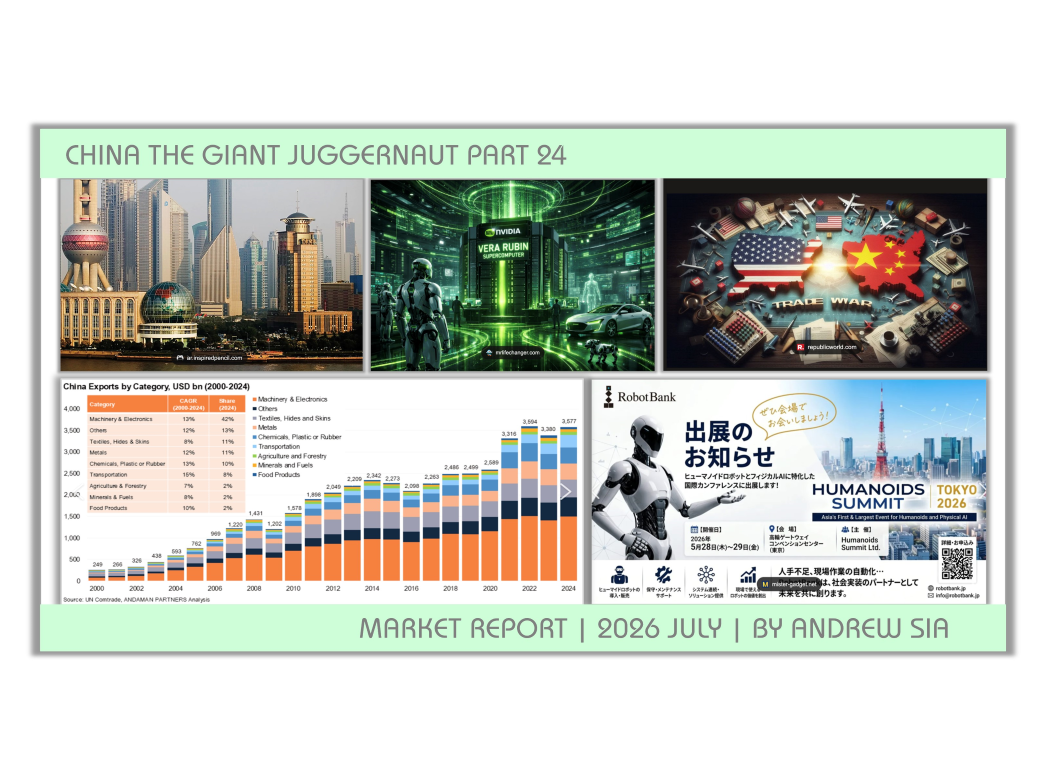
In August, China sold $119 billion more goods than it bought, it is the fourth month in a row that its trade surplus topped $100 billion. Its export value climbed 25% in dollar terms from a year ago while imports climb 28%. This year the trade gap so far is already over $800 billion, and it is on par to surpass last year’s $1.2 trillion.
Earlier on, the U.S. tried to unleash a hefty tariff on the country’s export, but after China’s hinting of choking off rare-earth exports, the two countries came to a truce.
In July we saw the trade deficit between the U.S. and China reached $29 billion, a 44% increase, the widest jump after Trump entered the White House in January 2025.
At home, China is growing at its lowest rate in three years. Instead, it is switching more towards its overseas markets where its cheap goods are welcomed. In Southeast Asia it grew 26%, and more than 25% in Africa. Its export to Canada has also grown more than 10%.
Exports of its semiconductors and automatic data processing machines grew nearly 130%.
Demand of its EVs from China has remained strong, all due to the war in Iran where it has pushed the oil price higher.
Officials in the developed countries are worried about the growing dominance of Chinese companies across a variety of goods flowing into their countries. It is also the result of heavy government subsidies that favor the Chinese companies. The EU trade commissioner gave China the deadline to provide their willingness to rebalance a trade deficit with Europe. They are also asking China for more assess to the China market. We will hear more about this shortly.
Also at the G20 recently this trade imbalance was tabled. There will also be a meeting in Washington during end September between Trump and Xi Jinping. The trade issue will be something to bring up.
Whereabouts is China’s Supercomputers?

Supercomputers is a term for the largest machines dedicated to science. It has been used in the 1960s for tasks like creating weather models, cracking codes and designing nuclear weapons. They typically using high-precision mathematics, expressing numbers with 64-bits of data.
To prevent China from catching up, Trump imposed tariffs and ban the AI chips export. China can’t lay their hands on superfast microprocessors—GPU (Graphic Processing Unit) and settled for standard microprocessors—CPU (Central Processing Unit) and came up with something impressive.
Lately, at the Shenzhen Cloud Computer Center, it declared its system to be the world’s fastest computing system going through a set of standard tests for supercomputers. It is using the standard CPU as the underlying design to blend artificial intelligence with traditional scientific tasks.
It toppled El Capitan; a system developed at Lawrence Livermore National Laboratory in California that had topped a ranking of supercomputer performance for two years.
This new supercomputer adds to the race between China and the U.S. for technological supremacy.
The U.S. tech giants like OpenAI, Anthropic and Google have developed leading AI models. Nvidia has become the world’s leading supplier of AI chips. Last year China brought out start-up DeepSeek using a tiny fraction of specialized chips.
Although the U.S. companies have historically dominated the ranks of the very large supercomputers, a system in Japan ranked No. 1 on the list from 2020 to 2022.
Because of the challenge, the industry pushed the Department of Energy for more fundings for the supercomputers. Last November, Trump administration started the Genesis Mission with aims to develop supercomputers at national labs and private companies to supercharge AI and other scientific research.
It has been suspected that China have systems capable of the No. 1 ranking, but they have not submitted their test results. Lately, its 14 submissions promoted sophisticate problems in science and simulation of Earth, including atmosphere, ocean, land and ice components
The World of the Humanoids

Japan was an early pioneer in humanoid robotics. Honda began its bipedal robot research in 1986, unveiled its autonomous humanoid P2 in 1996, and introduced ASIMO is 2000. ASIMO became one of the world’s best-known humanoid robots and demonstrated that a machine could walk, climb stairs and operate within an environment designed for humans.
But now, just as tech investors, start-up founders and government officials around the world are betting that artificial intelligence will spur growth for robots, that lead no longer belongs to Japan.
It belongs to China now. In May, at the Humanoids Summit, a robotics conference in Tokyo, which could have been a victory lap for an industry built on decades of development and investment instead centered on a different topic: “How Japan companies can break through in a market increasingly dominated by Chinese rivals”.
A dancing robot from China’s Unitree Robotics had stolen the show and managed to draw the largest crowds. And Chinese manufacturers are dominating the humanoid robot supply chain. They are producing thousands of robots selling for less than $5,000 each. No one can match China’s price as today China can produce sensors and joints all by itself as before it was depending on Japan for the supply. This has led the process for the components to drop.
It is without any announcement; China has established a commanding lead in a segment of the robotic industry that is economically useful: the factory automation.
China has been making and installing factory robots at a pace unmatched by any other countries. In 2024 alone, more than two million robots were operating in Chinese factories. In 2025, there were 354,000 robots being installed. This represented 59% of worldwide installations. This is more than the rest of the world combined.
But on the other hand, robot installations declined in Japan, the U.S., South Korea and Germany. In contrast to this, Chinese government has announced a campaign urging companies to use robots.
Being the largest electric vehicle manufacturers, China has a strategy on producing nearly all components locally, from lithium-ion batteries to screws and this enables the supply for parts for making robots. Many of these parts are 3-D printed. The main items it still imports are computer chips to control the robot’s movements.
Chinese investors have spent over $5 billion into humanoid robot start-ups in 2025, an amount equivalent to the total amount over the previous five years. This surge underscores a growing belief that humanoid robots could become one of the most significant ways artificial intelligences take up its physical form in the world.
Unitree had passed a regulatory review that could allow it to sell its shares publicly in Shanghai. Nearly 50 other robot-related company are waiting for their IPO in Hong Kong.
These companies are struggling to build software capable to stimulate the robots how to think and act. They are relying on Nvidia chips and software for reasoning and decision making. The latest version of the robot is expecting in the market soon.
Most of the robots that Unitree has sold in the last two years are for the universities, laboratories and other research settings. Developers are exploring how software can interact with robot hardware. It is actually not for labor performing as the original intension. Currently only 30% of the robots are doing manual work, although some companies would like to raise it to 50%.
To engage robots in the automated production lines and take up dangerous tasks like monitoring factories for chemical leaks, spraying of paints and moving heavy loads. These roles in complicate environments are yet to be solved. The potential is still very big for the humanoid robots.
University System in China
China is growing its educational partnership with countries across Asia, Africa, and the Middle East in the past decade. These outposts are capitalizing on its rising prestige of China’s universities which have gone through a three-decade-long transformation in both scale and quality. China is growing its soft power also in the educational arena.
In 2010, there was only one mainland Chinese institution ranked in the top 50 of the QS World University Rankings. By 2025, that number had risen to five, and they were positioned high on the global league table. We can refer to the following:
QS World University Rankings – Top 50 Institutions from China

China’s ascension is underpinned by heavy spending on science and technology. As the result, the quality of much of the research has brought its rising stature and influence on the country’s technology sector.
It is the fact that China has filed more patents and publishing many scientific papers than the U.S. as admitted by the American Association for the Advancement of Science. It is known that China invests 4% of its GDP in public education and around 2.68% of its GDP in research and development.
It began in the 1980s when its premier, Dang Xiaopeng, who recognized how far China had fallen behind the West and Japan during the Mao’s era. The succession leaders—Jiang Zemin, Hu Jintao and Xi Jinping—each introduced policies to strengthen the competitiveness of China’s universities.
The Ministry of Education has explicitly sought to raise the stature of its universities has accomplished the result. The elite group of universities, led by Peking University and Tsinghua University, are granted for progressive larger budgets over the years. This group of 10 elite Chinese universities each have a budget of $5 billion a year. Still, the top 10 remains dominated by Oxbridge and top elites in the US—MIT and Harvard.
In contrast to China’s heavy spending on education in areas of science and technology, on the contrary, the Trump administration openly criticized on research funding at leading US campuses. This triggered the anti-Chinese sentiment in the U.S. Together with its tightening of the immigration law, Chinese universities have success in attracting prominent academics to come back home.
China has capitalized in its investment in tertiary education to improve economic productivity and move up the manufacturing value chain. The research papers have been translated into technological breakthroughs that improved its industrial competitiveness. We have seen their research from labs that developed powerful battery technologies later used by leading companies in the electric vehicle sectors, for example the CATL, who is the world’s largest manufacturer of lithium-ion batteries for electric vehicles and energy storage systems, and BYD, the world’s largest electric vehicle by volume of vehicle sale. In the biotech field, BGI Genomics is leading the biotechnology in genetic testing, sequencing services, and precision medicine solutions.
It has been known that Chinese undergraduates have shown a lacking in critical thinking skills during their final two years of their degrees. By contrast, American students entered university with similar levels of critical thinking but made significant gain by graduation. We can also tell by the fact that Chinese students have been created before they arrive at the university because of their secondary educational system is built on six years.
By the way, under the English system after the five years of secondary school, we have the matriculation advance level, which is three years, before we can be granted into university education, which is another three years,
China has targeted scholars in strategically important fields such as physics, computer science, and biology. Earlier on, its “Thousand Talents Programs” who provided its researchers to study in overseas universities and institutions with substantial research funding. But lately with concerns about hostility towards foreign researchers and visa holders in the U.S., the Chinese-born academics have returned home from the U.S. in recent years. They have also drawn prominent foreigners for their relocation in China, and they have set up research labs in critical science.
In 2023, China spent $781 billion on R&D against the U.S.’s $823 billion. In 2007, it was only $136 billion against $462 billion. China is quickly catching up.
China spends on average $305,000 on R&D costs per researcher while Europe’s average is $268,000.
China has long sought to build universities with global presence as a means to project its own soft power and export its technologies particularly in Asia, the Middle East, and Africa, to establish institutes and research partnerships aimed at training the next generation of foreign talents.
China Shock 2.0

We are looking at the latest development of China as the World Factory, and unknowingly it has transformed into something which give the total solution to the industrial need.
For a change, China is no longer producing cheap toys, shoes, clothing and electronics, it is becoming a producer for factories in a new industrial transformation. Rather than supplying only low-value consumer goods, it is exporting more of the higher-value intermediate and capital goods that underpin global manufacturing, such as chips, precision machinery and robotic arms. In the past, the advanced manufacturing was led by Germany and Japan, but this technology has been caught up by China.
China’s dominance over greater parts of global supply chains is making the country’s export more formidable and resilient against tariffs, which tends to target finished goods. In the first half year, its export of intermediate and capital goods jumped 25% and 12% respectively.
This transformation is threatening advanced-manufacturing economies such as the European Union, Japan, and South Korea. Products of chemical, batteries and other industrial goods in those economies were once depending on China factories as customers, have faced their competition in their home markets. For the first time, Germany is importing more capital goods from China than it exported there.
This shift is raising alarms worldwide, and the “China Shock 2.0” is a threat now.
China’s evolution from the world’s consumer assembly line to an advanced-manufacturing powerhouse was years in the making. China’s policies encouraged higher local content, boosting production of components in China under its initiatives of funneling subsidies, tax breaks, and cheap loan to small and midsize companies in specialized, high-tech manufacturing sectors.
Economic logic is driving a very large share of manufacturing in China. Its supply chain is also well developed when compare with the Southeast Asian countries. But its domestic market and fierce competition accelerated its industrial upgrading. Its supplier network and infrastructure also make production highly efficient.
The overall U.S. tariff rate on Chinese goods is slightly above 23%. China is doing well because of their scale of producing things that is much cheaper. Meanwhile, China has kept its baseline retaliatory tariffs on U.S. goods at 10% under the bilateral agreements.
Producing outside China where semiconductors and aluminum used in the products have to be imported into those countries from China and South Korea.
For those Southeast Asian countries, cost for using their seaports is 12 to 15% higher than China seaport because of complicated bureaucracy and worse infrastructure making it more difficult to get goods to port.
In recent months the American companies have shifted their sourcing of products back to China as shortage of oil from the war with Iran further strained factories in countries like Vietnam.
China still has massive advantage with its supply.
While the U.S. is trying to stabilize its relationship with China, it is unlike that it was a year ago when they have extreme tariffs on each other. The question is when will the U.S. tariffs on China be ended.