
2026 JANUARY ISSUE
THOU SHALT NOT KILL

Written by ANDREW SIA
Share this article !
From the Desk of the Publisher

When I tried to put this report together, my heart has been very heavy. I tried not to take side to say who is right or wrong, I only want to point out that for any war there is no winner or loser. In the end, we all lost, and the hardest part is the loss of life. As of now, Iran has launched drone and missile attacks against at least 10 to 12 countries in the Middle East and beyond. Key targets have been Saudi Arabia, UAE, Qatar, Kuwait, Bahrain, Iraq, Jordan, Azerbaijan, Oman, Israel, Turkey, and Lebanon.
Attacks have targeted critical energy infrastructure in Qatar, Saudi Arabia, and UAE.
Brent crude oil prices have surged in the last two days, and reported to have raised to $112 to $119 per barrel. Analysts are already suggesting prices are threatened to go higher if supply disruptions in the Middle East continue.
The situation doesn’t look good.

Introduction
In a world that has grown accustomed to conflict, war is often spoken of in the language of necessity — security, survival, and national interest. These words are repeated so often that they begin to sound reasonable, even inevitable. Yet beneath them lies a quieter question, one that is seldom asked: what becomes of us when the taking of life is accepted as part of the solution?
As we witness the suffering of others and the loss that follows in the wake of war, we are compelled to pause — not to judge but to reflect. For beyond strategies and justifications, there remains a simple and enduring truth: a life once taken cannot be returned.
The Path to Conflict
On February 28, 2026, U.S. President Trump launched a new war on Iran. It was supposed to be a shock-and-assault military strike against Iran alongside with Israel, that killed Iran Supreme Leader Ayatollah Ali Khamenei. In the first wave of “Operation Epic Fury,” 30 Iranian generals and nine nuclear scientists were killed within minutes of the assault.
On the first day of the war, more than 200 civilians were killed in strikes across the country. One of the deadliest incidents occurred in the southern city of Minab, where a strike on a girls’ elementary school killed at least 85 children.
According to Trump, the war was supposed to last four weeks. He framed it as a “little excursion,” noting it was a limited engagement similar to his recent actions in Venezuela, though critics and some military analysts have expressed concern about it becoming a prolonged conflict.
But experts are saying that it has changed the world in under its first two weeks; it has shuddered the global security order and economy that far exceeds those delivered by other recent conflicts in the Middle East. The war has already reshaped travel patterns, energy dependencies, living costs, trade routes, and strategic partnerships. Countries typically shielded from regional conflict — Cyprus and United Arab Emirates — have faced retaliatory Iranian fire.
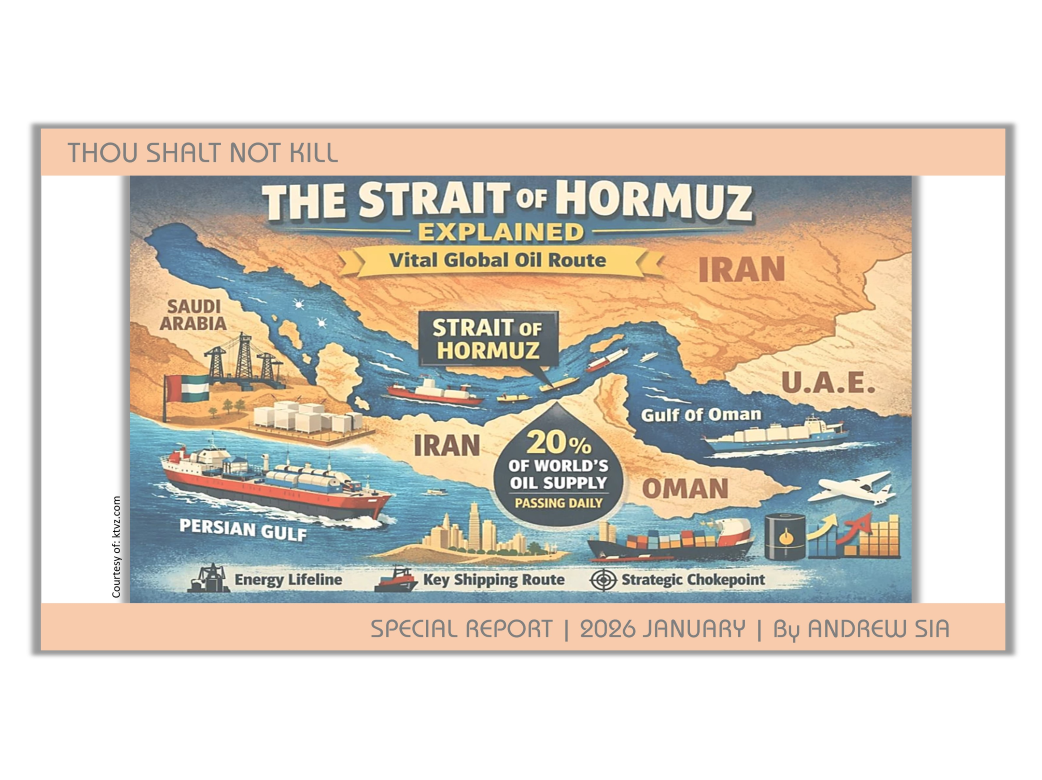
In fact, these effects are compounded with the pressing ahead of the war, and Iran has escalated the counterattacks and continues to block ship traffic through the critical oil passage of the Strait of Hormuz. Normally, about 20% of the world’s oil would pass through the strait. Iran has struck at least 19 vessels in the Gulf region since the outbreak of hostilities. Now Iran’s new supreme leader Mojtaba Khamenei has declared the strait closed to shipping.
This choke on the world’s oil supplies has pushed the price of Brent crude above $100 per barrel. Despite Trump’s promise that the U.S. would provide naval escorts to commercial vessels, no protection has been forthcoming. And Trump has been threatening the NATO if they didn’t join the U.S. effort.
Strategic Flashpoints
Strait of Hormuz as the Choking Point – International Maritime Organization (IMO) also stated that naval escorts through the Strait of Hormuz will not be easy due to the geographic layout of the strait. Its width at its narrowest point is 33 km while the combined width of the deep-water shipping lanes in each direction is only 4 km. It is bounded on the Iranian side by mountains. Geographically, it is like a trap.

Access to ports is limited as they have been targeted. Between March 2 and 14, 2026, only 47 cargo vessels and tankers have passe through the strait.
Europe’s three biggest military power — the United Kingdom, France and Germany — have all rejected Trump’s demand that they participate in a naval mission to reopen the Strait of Hormuz, despite Trump’s threat that such rejection would mean a very bad future for NATO. Leaders of these three countries also expressed they didn’t want to be dragged into any open conflict against Iran. They pointed out that NATO is a defense alliance, not an intervention alliance, and targeting Iran and its nuclear program is a “war of choice” by the U.S. and Israel.
It’s important to note that before this current conflict, approximately 100 to 138 vessels passed through the Strait of Hormuz on a normal day, carrying roughly one-fifth of the global oil supply and over 20% of global liquefied natural gas (LNG).
Counterattack from Iran – Total numbers of Iranian strikes recorded on Gulf nations has surpassed 1,400 since the conflict began, and more than half have targeted the United Arab Emirates.
Trump turned around and asked China to help to unblock the strait before his travel to Beijing to meet with Xi Jinping. His reasoning is that China is depending on 90% of its oil supply from the strait.
We saw the resignation of Joe Kent, former director of the United States National Counterterrorism Center, after he wrote on X that Tehran doesn’t post any imminent threat to the U.S. He was a veteran who served other U.S. wars in the Middle East. He claimed that it was the senior Israeli officials and influential U.S. media who created an illusion for Trump to fall in and took Iran as an imminent threat. It’s a matter of what you choose and what to believe about this war, and this is the most unfortunate.
The Cost of War
The Economics of Ammunition – In this war we have seen the contrasts of spending on the warfare. Expensive systems designed to provide defense against enemy aircraft and large missiles are outdated in the battlefield. Iran learned from Russia’s full-scale invasion of Ukraine how drones can be used to intercept the attack.
The war in the Middle East where firing missiles from complex and costly air-defense systems such as the U.S. Patriot is not cost-effective, especially the use of fighter aircraft and anti-air missiles to intercept Iranian drones. It’s a very costly operation. The cost of shooting down an Iranian drone with the use of a medium range missile such as the U.S. National Advanced Surface-to-Air Missile System is $1 million to $2 million per shot. Drones offer a technology with the ability to innovate quickly and manufacture at scale. The four years of war in Ukraine have driven the technology to another level. It is being speculated that China was equipping the drones for use in Iran.
Oil Reserves and Strategic Releases – This war has already triggered the biggest release of strategic oil reserves in its history. The International Energy Agency (IEA) needs to stabilize the turmoil in energy markets unleashed by the Middle East war. The agency announced that it would release 400 million barrels as an emergency action. IEA has a total of 32 member countries, and it is based in Paris under an autonomous organization within the Organization for Economic Cooperation and Development (OECD) framework.
Under the IEA program, member countries hold about 1.2 billion barrels in strategic reserves that can be tapped in as emergency. This has been done five times since the agency was founded in 1974. It was created in November that year in response to the 1973-1974 oil crisis to help those industrialized countries to coordinate a collective response to major oil supply disruptions. This action has been taken only five times in address the following crisis:
Arab Oil Embargo in 1973
Gulf War in 1991
Hurricanes Katrina and Rita in 2005
Libyan Civil War in 2011
Russian Invasion of Ukraine in 2022
The closure of the Strait of Hormuz is causing the transport stoppage of 20 million barrels of oil a day, or a demand of 20% global demand. The U.S. has the largest strategic oil stocks of any IEA member with 416 million barrels stored in salt caverns on the U.S. Gulf Coast. In theory it can release 4.4 million barrels a day in according to the U.S. Department of Energy.
As noted, the price of Brent crude is above $100 per barrel. The oil prices in Europe have doubled since the beginning of the war to approximately $107.81 per barrel.
Shifting Global Balance
Russia – The Unexpected Beneficiary
Russia is the only beneficiary in this war as it is earning as much as $150 million a day in extra revenues from its oil sales. Moscow has so far earned an estimate of $1.3 billion to $1.9 billion from taxes on oil exports after the closure of the Strait of Hormuz led to rising demand on Russian crude from India and China. The U.S. has also eased its pressure on India for its purchase of Russian oil.
Perspectives in Conflict
Israelis in the Big Picture – The overall attitude of Israelis toward the war with Iran shows that most Israelis support military action against Iran, and around 80% of the Jewish Israelis support the strike as a security necessity. Iran is known as an existential threat due to its nuclear ambitions, along with being a main sponsor of hostile groups such as Hamas and Hezbollah. Iran has always been a long-term strategic enemy.
For most of the Israelis, the war against Iran has been an essential to national survival, although there can be some conflicts in thinking. Iran has always posed a threat in the region, and under its Iran Supreme Leader Ayatollah Ali Khamenei, the region has been sitting on a landmine.
Americans in the Big Picture – But if we look at the U.S. public opinion, majority of Americans do not support the war. Only about 25% to 37% support U.S. strike on Iran, and around 43% to 59% oppose the strikes. Many Americans are uncertain or hesitant.
Americans fear another long war, like what occurred in Iraq and Afghanistan. The Iraq War lasted nearly nine years, spanning from the U.S.-led invasion on March 20, 2003, to its final withdrawal of U.S. troops on December 18, 2011. The war in Afghanistan lasted nearly 20 years, spanning from October 7, 2001, to August 30, 2021. It began after the 9/11 attacks and concluded with the final withdrawal of the U.S. troops making it the longest war in American history.
Americans are afraid of another long war that can bring causalities to the American people. It is already mentioned that this could be an attritional war. They also fear being drag into conflicts in the Middle East. Although Afghanistan is part of Asia, it is often considered as the Middle East in political and media discussions due to cultural, historical, and geopolitical ties. It is part of the “Greater Middle East” in the broader definition.
Also, the two political parties — the Republicans and the Democrats — can’t see eye-to-eye with this war. Most American viewing the war as a risky and potentially unnecessary conflict.
Conclusion
War may be justified in the name of necessity, security, or survival — all given as excuses. But these excuses in the end are explanations we give ourselves. We must not forget that in war, human lives are sacrificed, and once lost, they can never be restored. There are no true winners in war. In one way or another, we all come out losing. “Thou shalt not kill” is not merely a command. It is a reminder to pause, to refrain ourselves, and to seek a better path where life is reserved, and where, it possible, both sides may yet emerge with dignity.