
2026 JULY ISSUE
THE SKIT
ABOUT THE COMING OF
AUTUMN

Written by ANDREW SIA
Share this article !
From the Desk of the Publisher

The longingness of the Summer has led me to write something about those wonderful moments of the season which is coming to an end. In fact, all the Seasons are lovely, and they are different from one another. And because they all pass very quickly, they have left us in wonder for where the time has all gone so swiftly.
You may take this as a nostalgic piece as I have written, for the first time, I am showing to the public my emotional side. Also, due to the fact that the things around us have made our life harder and not easier, I have to look for nature for consoling.
Nature is by no means easy, with the global warming, the El Niño effect, which is the strongest in decades, it is going to last through 2027. We have already seen a lot of floodings in many places.
We are all so fragile already, and the wars in Iran and Ukraine, if not stop faster and earlier, they would only add more misery to all mankind.
I only want to say that “Nature changes the cast, but the show goes on.”

Opening Remark
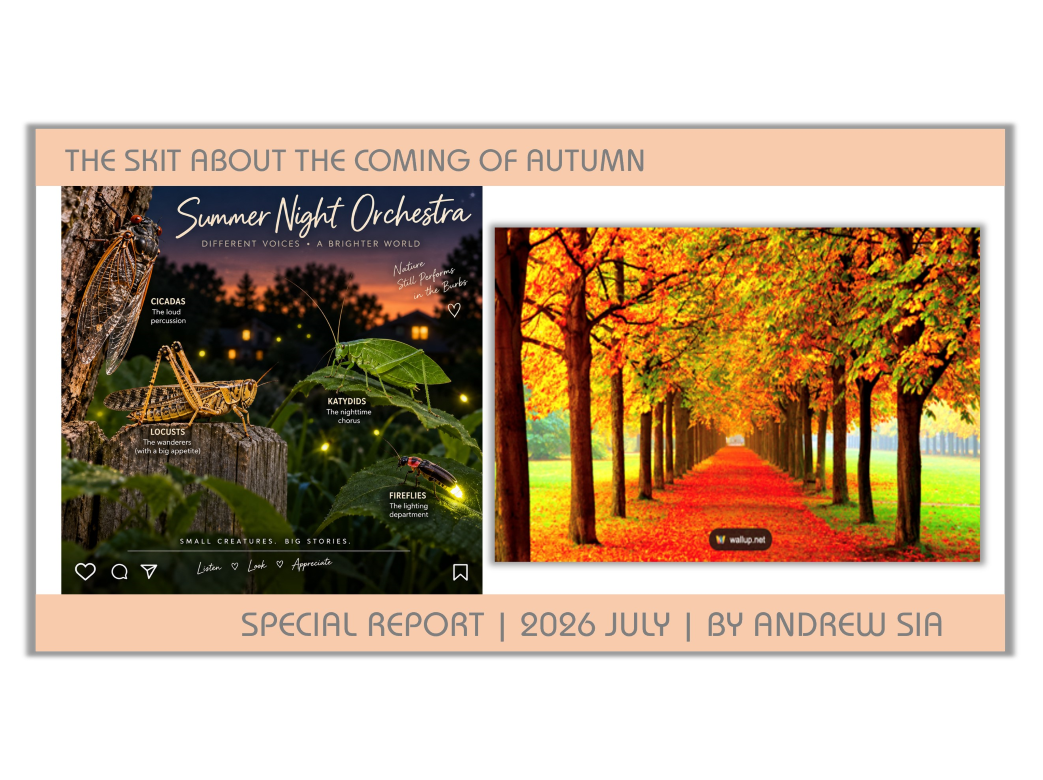
Sometime ago, I wrote about a piece entitled “Sex in the Burbs.” It was about those wonderful summer nights when cicadas, crickets, and katydids play their symphony, while the fireflies are providing the lights. What a beautiful picture nature has painted for us.
Soon, Summer will take its final bow and leave the stage. Autumn is waiting in the wings, ready to make its entrance on September 22.
The orchestra of the summer night will gradually grow quiet. The little flashing lights will disappear. In their places, Autumn will bring us another performance—the changing colors of the landscape, followed by the fallen leaves.
This time while I am working in my atelier, I come across the two of those “late night” performers—the fireflies and the cicadas. Let me tell you their stories.
Fireflies
An adult firefly lives only a brief life, often measured by weeks. Yet its entire journey —from egg to larva, then pupa, and finally the glowing beetle we see on a summer evening—may take many months, and in some species as long as two years.
After mating, the female lays her eggs in moist places, often in soil or among leaf litters. The eggs hatch into larvae, which spend most of their lives hidden from our sight. Eventually, they emerge as the little lanterns that illuminate our summer nights.
For generations, this soft glow lightening bugs has been part of the steady rhythm of nightfall. Thousands of tiny lights once flickered across fields, gardens, wetlands, and the countryside. Lately, however, in many places their lights appear to be fading. Habitat loss, intensive agriculture and pesticide, artificial lighting, and a change climate can all disturb the environments and mating rituals on which fireflies depend.
Earlier, I wrote about the summer night orchestra—cicadas, crickets, fireflies, and katydids, come alive after sunset. The cicadas, crickets, and katydids provide the music, while the fireflies provide the lights. Each, in its own language, is calling to its kind in the search for a mate, and in the summer night they call on their own species for mating. Together, they create a performance that belongs only to summer.
But summer is coming to an end.
Soon the orchestra will grow quiet, the little lanterns will disappear, and the curtain will fall on another season. Then we will have to wait until the next year to meet our little friends again in the burbs.
Cicadas
This time we read about a tiny country—Singapore, a jungle island roughly 85 miles north of the equator—is no stranger to cicadas. There are now ten known species living on this tiny island. Its residences are battling when tens of thousands appeared, annoying locals with their loud songs and haphazard flying.
These orange-winged cicadas had previously been found in the Philippines, and how they could have moved in larger swarms to Singapore is unknown.
Cicadas are found banging into the bedroom windows and disturbed the people from sleeping. Residents would use shawls and umbrellas to protect themselves when walking outside.
A “Cascade Management Taskforce” has been form by the local communities who would wrap foil or plastic around trees. They hope to disrupt the molting process of cicada nymphs, which need to shed their outer layer to emerge as adults.
I just found out that cicadas are edible and have been eaten by people in various cultures for centuries. They are insects, so nutritious they provide protein, fats, and minerals. But they need to be cooked thoroughly, and it is important to avoid collecting them from areas treated with pesticides or other chemicals. The wings and legs are removed, and only the body part for eating. Beware of allergies, as shellfish allergies are to be watched.
Locusts
I have heard that locusts can also be eaten, and they are eaten in various parts of Africa, Asia, and the Middle East. Locusts can be a good source of protein, fat, vitamins, and minerals.
They can be roasted or fried and cooked with spices and added to dishes as a crunchy protein.
It is advisable not to eat them unless you know that they are safe. Always avoid them from affected by pesticides and other chemicals.
Locusts are known throughout human history, and they have also been greatly feared. We read about them in the Book of Exodus, when locusts became one of the ten plagues of Egypt. They swamped across the land and devoured what remained of the crops. And thousands of years later, they can still gather into enormous swamp and descend upon agricultural land.
Katydids and Crickets
Katydids are closely related to crickets. Crickets are bright green in color and closely resemble to leaves and help them to blend into trees and shrubs. Their long, thin antennas are often long than their bodies.
You find them in tropical countries, and they live in forests, gardens, grasslands, and bushes. They eat leaves, flowers, and fruits.
Male katydids chirping and buzzing by rubbing their wings together to attract females. They hatch from eggs into wingless young nymphs and gradually molt several times before becoming winged insects.
They are not considered as pests, and they are harmless to people. They nibble on garden plants, and important to ecosystems. They are often preys to birds, bats, and spiders.
Conclusion
What I would classify this summer night combo with the different performers:
Cicadas – the percussion section
Crickets – the chorus section
Katydids – the string section
Fireflies – the lightshow
Together they make the summer symphony complete with its own musicians and lighting crews.