
2026 JULY ISSUE
INDUSTRIAL REVOLUTION
4.0
CASE STUDY #1
AUTOMOBILE INDUSTRY

Written by ANDREW SIA
Share this article !
From the Desk of the Publisher

For our Case Study #1 we picked the Automobile Industry and we used Volkswagen, the world’s second largest car company which shows the challenge the industry is facing. For its cost saving, which can also mean its survival, Volkswagen is compelled to reduce 100,000 employees and closing four of its German factories. This is the plan and this means a sixth of its global workforce. Reducing its workforce can improve the carmaker’s odds.
The obstacle will come from its trade union, and an average cost of an employee is about €70,000 a year, so the cut would save around €7 billion a year. Factory closures can save €3 billion from capital expenditure. We are looking at a total of €10 billion in total, and when spread this across its last year’s sales of 9 million cars, this is around €1,000 per vehicle.
This would narrow the gap between China, and it is a common acknowledgement that China’s EVs are between 20% to 50% less than its European counterparts. This implied a gap of at least €6,000 per vehicle.
EU imposed tariffs on battery EVs from China and may do the same for the hybrids to offset its state subsidies.
Other European carmakers will follow Volkswagen down the path, but in the longer run a policy to revive the car industry and to come out from this doldrum is absolutely necessary.
It is already known that China can build a small EV for its China market and sell it for $6,000 to $7,000 only. This is already a nightmare for the Western World.

Introduction
Basically, you can say that for every century we have something major in the industrialization of our civilization. Started in 1700s we have the First Industrial Revolution, and since then in 1800s, 1900s, and now 2000s, we never looked back.
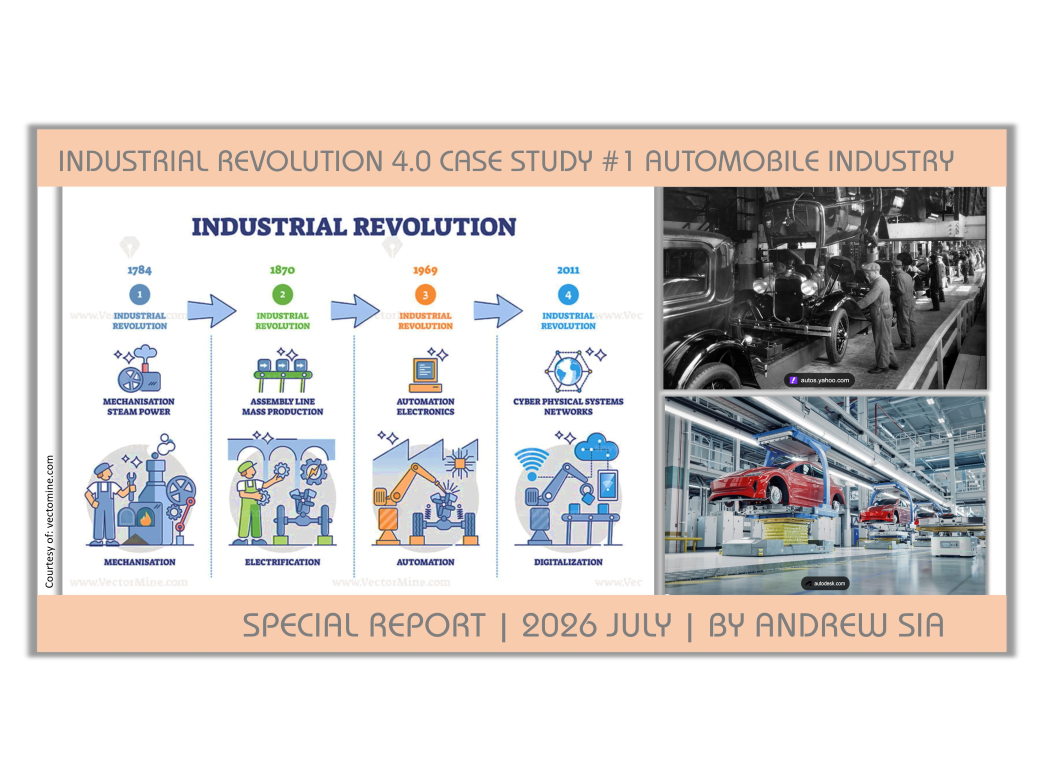
A recap for the major industrialization to mark the centuries:
Industry 1.0 – Steam and Mechanization
Industry 2.0 – Electricity and Mass Production
Industry 3.0 – Electronics, Computers and Automation
Industry 4.0 – IoT, Semiconductors, Data Centers and AI
We are going to call for case studies in different fields, and we would take the study based on our sequences as the following:
Case Study #1 – Automobile Industry: The Machine Becomes Intelligent
EVs, batteries, robotics, semiconductors, software-defined vehicles, autonomous driving and China’s rise.
Case Study #2 – Fashion Textile & Industry: From Forecasting to On-Demand
AI-assisted design, demand forecasting, digital sampling, automated cutting/sewing, RFID, nearshoring, responsive production/on-demand model, sustainability, circularity and resale, and fashion branding.
Case Study #3 – Logistics & Supply Chains: The World Becomes Connected
Maritime routes, canals and chokepoints, smart ports, geopolitics and geoeconomics, automated warehouses, robotics, AI logistics and resilience.
Case Study #4 – Energy: Powering Industry 4.0
Smart grids, renewables, batteries and storage, nuclear power, AI-managed electricity systems, and the rapidly growing requirements of data centers.
Case Study #5 – Agriculture & Food Chain: Digital Farming
Autonomous machinery, drones, sensors, precision irrigation, satellite imagery, AI crop management, robotic harvesting, and food distribution.
Case Study #6 – Factory of the Future: Human + Machine
Robotics, cobots, machine design, predictive maintenance, digital twins, increasing machine autonomy, “lights-out” manufacturing, worker retaining, and new occupations.
Case Study #7 – Education & Job Market: Preparing the New Mankind
Curriculum redesign, AI-assisted education, apprenticeships, vocational and technical skills, lifelong learning, promoting on developing wisdom, introduce humanity, and emphasizing humility.
Case Study #8 – Healthcare: The Machine Meets the Body
AI-assisted diagnosis, medical imaging, robotic-assisted surgeries, wearable devices, remote patient monitoring, personalized and precision medicine, digital twins, smart hospitals, and AI-assisted drug research.
These are the technologies transforming industry. We are studying how far they will take us, and what choices should human beings make along the way? We have many questions that are waiting for our further explorations.
Can intelligent robots restore manufacturing competitiveness while creating worthwhile roles for human beings?
For instance, healthcare needn’t ask whether AI will replace doctors. We should ask how AI can extend medical capability without diminishing human judgement and compassion.
Education can become the most important one. If machines can become increasing intelligent, what should we teach human beings that machines cannot—or should not provide?
I can tell you that I am fascinated by what these technologies can accomplish, but I am not convinced that everything is technologically possible is necessary the desirable answer. Therefore, rather than predict the future, I would like to invite our readers, and the professionals to participate in this study to examine the choices before us.
Remember Industrial Revolution 4.0 is not one destination; it is a collection of choices. Collectively, I am asking my working committees of engineers, manufacturers, doctors, educators, and other professionals to take part under this approach.
Industry 4.0 is asking what intelligent machines can do, and our study is asking what we human beings should do with them.
Now we are entering into the Age of Artificial Intelligence in Industry 4.0, and it will take us to do the study on different schedules, and will extend from our July 2026 issue, and then move on to January and July 2027 issues, until we have completed the full study.
We will form committees to ask for more advice in order that our knowledge will not be outdates.
Case Study #1 – The Automobile Industry: The Machine Becomes Intelligent

For decades, Volkswagen, the German-engineered cars are selling around the world and is the largest auto-engineering company in Germany. Its name, Volkswagen, literally means “people’s car.”
Today it is the second-largest automaker, next to the Japanese’s Toyota.
Volkswagen is facing challenges on multiple fronts. It is going through many changes, and the cost reductions have been the most difficult in the current economical and geopolitical environment.
At the end of last year, Volkswagen was still employing about 660,000 workers for its sales of 9.2 million vehicles—about 14 vehicles per employee. The Detroit Three—Ford, GM and Stellantis—produced 4.8 million vehicles and hired 265,000 workers. It was 18 vehicles per worker. Its operating profit also fell to 2.8%, its worst performance since 2015.
It is worth mentioning the worst year for Volkswagen was in 2016, during that year, Volkswagen was forced to buyback 590,000 diesel vehicles in the U.S. The settlement was worth up to $14.7 billion for buybacks, repairs, environmental mitigation, penalties, and other settlements. This Volkswagen diesel scandal, often known as “Dieselgate,” became one of the automobile industry’s biggest corporate scandals.
This time, its Chief Executive, Oliver Blume, has outlined an ambitious financial performance to achieve a margin of between 8-10% by 2020. Obviously, its restructuring would be a very painful process.
The first thing that it must do is to close factories which will have an impact on its workforce. We need to know that labor is unusually powerful at Volkswagen, and its union representatives have the 20% stake held by the State of Lower Saxony.
Prior to its “Dieselgate” in 2015, Volkswagen was riding on the booming of the Chinese economy which began to takeoff in 2010, the company added more than 200,000 jobs globally. Its employment peaked 684,000, and the blow came during the Covid pandemic, and shortage of parts inflated profits across the auto industry. Since then, the company’s profit has been dwindling, and agreement with the union has reached to shed 35,000 jobs in 2030. With its other German subsidiaries, Audi and Porsche, to bring the total to 50,000 and it was agreed to cut labor but not to close factories.

Its progress has been very slow and largely relying on early retirement programs and voluntary layoffs. Also, 43% of the Volkswagen’s operation were in Germany in 2025, unlike the others, like Toyota, was only 17% in Japan. Its labor cost in Germany is higher than many countries, such as Portugal, Romania, and Hungary, which are less than a third of Germany’s standard.
Its energy is also more expensive than in many other European countries as it can no longer benefit from the cheap Russian gas before the war in Ukraine. Its plants in Portugal and Spain are far lower than its plant in Germany, there Volkswagen has some of its most competitive plants.
Volkswagen has never benefitted from its acquisitions of other car brands; there are 12 core brands and each of them is still maintaining its management board. The sharing of technologies and components are not being maximized, and this added the unnecessary cost. The company still makes more components than its competitors, and that is the reason why it is employing more workers.

Volkswagen’s decision to make its own EV batteries, while most competitors are outsourcing or to have joint ventures with battery specialists. Volkswagen has taken the steps to invest in overseas companies. A typical example has been shifting its product development to China in order to grow its business there.
Earlier on, we wrote about the Volkswagen venture in China in our “Globalization 2.0” we pointed out that China is Volkswagen’s most important market for years. They have factories, joint venture with SAIC and FAW where it sold millions of cars annually.
Volkswagen has made a major strategy shift, that is “In China, for China.” And it is now localizing everything, including full R&D centers in Hefei, China. It is designing cars specifically for Chinese consumers and even developing chips and software locally. This can bring its products to the market about 30% faster. This operation can now design, test, produce entirely in China and this is a big change from the old business model where Germany led everything. China is no longer just a market; it is becoming a manufacturing and innovative hub where its China-made cars will export globally.
Volkswagen is doing this because they are under pressure as they are losing market share in China to BYD, Geely, Chery and the others. They have found that Chinese EV competition is extremely strong. At home, Volkswagen has high energy costs, slower EV transition, and structural industrial pressure. This move from Volkswagen makes sense.
Its deliveries fell 25.9% in the first half of 2026. Competition will continue to intensify.
But they still have to compete with the auto makers in China as they have all been subsidized by the state, this can only intensify its presence in China. This is not only Volkswagen’s challenge in China, but the other auto makers are also facing the same problem. China’s enormous automobile capacity and intense price competition has put pressure through the auto industry.
Originally its ambitious objective of roughly 4 million Chinese sales by 2030 and about €3 billion in operating profit would now seek to be more unrealistic.
But on the other hand, this year the consumer spending in China is extremely soft. Year-on-year retail sales grew only 0.4%, fix-asset investment fell 7.2% in January-August, private investment fell 10.1%, and real-estate development investment plunged 19.9%. These figures can tell you how China is doing this time.
China’s advance manufacturing is still strong increased by 5.2%, its manufacturing output +6.1%, equipment manufacturing 12.1%, and its high-tech manufacturing16.7%.
You may say that China’s production is still strong, but its consumers and property-sector are much weaker. The selling of cars is not that great either.
China may still be an increasingly attractive place for Volkswagen to develop and manufacture automobiles, while simultaneously becoming an increasing difficult place for Volkswagen to sell them.
What is in front of Volkswagen which we are going to bring out, is something very challenging for the auto-industry, and it is not only what Volkswagen has to deal with all by itself. It has to cut half of its models to reduce cost, as the company has grown to be too big and complicated.
Volkswagen has 111 production facilities on every continent except Australia and Antarctica. It has brands like Audi, Porsche, Skoda, Lamborghini, and Bentley. Some of its brands are offering very similar cars with slightly different designs and features. They only increase costs and complexity.
In the European Union and Britain, Chinese automakers sold more vehicles than Japanese carmakers according to data in May. Supported by government subsidies, China was the first country who focused on electric vehicles before the others have spotted the potential. Now about one in every five new vehicles sold in Europe is electric, and sales surged because of the increase in fuel prices caused by the war in Iran.
For many years China has been Volkswagen’s top market. Its profit is also came from its selling there. This time its sales plunged 20% and it suffered the hardest hit. It has already mentioned that any closure and layoff of its workers would bring political turmoil within the German political parties.

Volkswagen is the second largest automaker, and Toyota is the company similar in scale, employed 410,000 and sell 11.3 million vehicles, about 28 vehicles per employee. In comparison, Volkswagen employed 660,000 and sell 9.2 million vehicles, about 14 vehicles per employee.

So that we know in 2025 Toyota Motor Cooperation sold about 11.3 million vehicles worldwide, this includes Toyota/Lexus, Daihatsu and Hino, retaining the global No. 1 position.
It is also interesting to know that Volkswagen was founded on May 28, 1937, and it was a project tied to the German Labor Front to create an affordable “people’s car.”
Toyota Motor was established on August 28, 1937, after emerging from the Toyoda Automatic Loom Works.
Two companies born in the same year followed the remarkably different historical paths and eventually became the world’s two largest groups by volume. Both companies are approaching their 90th anniversaries in 2027, just as the automobile itself is undergoing one of its largest technological transformations.
The auto industry is certainly one of the world’s largest industries and most economically important industries. Its influence extends far beyond vehicle manufacturing into steel, aluminum, plastics, glass, semiconductors, electronics, batteries, software, energy, logistics, dealerships, financing, repair, and millions of jobs throughout the global supply chain.
The transition from fossil fuel cars to electric vehicles have enabled the rise of China in car manufacturing and this has upended many established carmakers. This is not what the German industry has expected as it comes too swiftly.
The catalysts for this new automobile industrial revolution are the rapid transition to electric vehicles and the surge of China as a major automotive power. Together, they have pushed the global industry to a turning point, forcing established automakers to re-examine the cards in their hands and reconsider how those cards should now be played.
Semiconductors, batteries, software, artificial intelligence, robotics, and data are becoming increasing important alongside the traditional strengths of mechanical engineering. Let’s watch it closely for its development.
In this first part of our study about the automobile industry, Volkswagen gives us the transformation story, and it is where this Industry 4.0 series is all about.
Further Analyses of the Industry
We bring in now our analysis on the report of the Automobile Industry because from what we have learned that the biggest player for the EVs—China is not just “China has cheap labor,” but it is about its industrial system. Its structural approach is totally different than the Western world.
China has software, electronics, batteries, automation, supply chains, manufacturing scale, and fierce competition drives for its survival. China built an ecosystem that makes the entire EV manufacturing process cheaper.
The International Energy Agency (IEA) estimates that producing a small SUV in China is more than 30% cheaper than in advanced economies. It identifies large-scale manufacturing and vertical integration as the principal reasons, with energy and labor costs contributing a smaller role.
There are the several layers that we are referring to:
Batteries are playing an important role:
China produced more than 80% of the world’s EV battery cells in 2025, and its share is even higher for some battery materials and components. IEA estimates that Chinese battery-cell prices are more than 30% lower than Europe’s and more than 20% lower than the U.S.’s. China has also been producing batteries at enormous scale for years and it has the advantage.
China controls much of the supply chain:
China accounts for roughly 85% of the global cathode active-material production and more than 90% of anode active-material production in 2025.
This vertical integration which includes battery materials, battery cells, battery packs, electric motors, power electronics, vehicle electronics, and software.
China has a domestic market:
Chinese manufacturers have an enormous domestic market in which dozens of Chinese companies compete intensely. In 2025, China produced about 16 million EVs, this is almost three-quarters of global EV production.
Because of this, its domestic market is also its laboratory, whereas it can experiment with:
– Batteries
– Autonomous-driving systems
– Software
– Vehicle electronics
– Manufacturing processes
– Different vehicle architectures
– Charging systems
– New business models
This learning curve is unique for China.
EVs are inherently more compatible with digital manufacturing:
When we look at an internal-combustion car, it is enormously complicated mechanical process. An EV replaces much of that with battery, inverter, and electric motors. These changes make the manufacturing to become closer to computer-aided manufacturing.
China’s manufacturing scale:
With the quantity it is producing, factory investment can be maximized, engineering, tooling, R&D, automation, logistics can all be spread over more production units.
The scale produces learning, learning produces lower costs, lower costs produce more sales, and more sales produce more scale. This is a circle that goes around.
China has a different industrial philosophy:
It starts with an electric/digital architecture, proceed to simplify the vehicle, integrate the supply chain, apply automate production, manufacture enormous volumes, and continuously reduce cost.
The traditional European approach is to take an existing automobile, replace its engine with an electric engine, add expensive technology, and sell it as an EV.
China achieved in 2025 the price of the EVs sold for 70% less than compatible Ignition-combustion engine.
Situation with the China’s EV manufacturers:

It has about 50 active domestic EV manufacturers and has 129 EV brands covering the expansive industry. The industry is already consolidating rapidly as more than 400 brands have reportedly collapsed since 2018, and only 15 of the 129 currently operating EV brands will be financially viable by 2030.
How China is going to realign this industrial sector is not going to be easy. Before we can look clearly what is in front of this global industry, every decision China is taking is not to be neglected.
How Can the World Compete
In recent years, the most frequent thing that we have heard about is the tariffs. “Put tariffs on Chinese cars” is often being used. The question is now for how long we can hold on to this this? In my opinion, it is not too long.
This has led us in deeper thoughts, and we should ask questions based on the following points:
We should learn to complete in the entire value chain, not just the automobile assembly:
We need to build from the ground up-a competitive battery to software, treat it as a vertical integration to achieve an industrial ecosystem. Remember we can almost assemble the complete vehicle by robotic.
Make manufacturing itself a 4.0 Industry:
We have to build a future factory where robotics and artificial intelligent fully integrated. The “future factory” should have the following:
– Highly automated assembly
– AI quality inspection
– Predictive maintenance
– Digital approach
– Autonomous material movement
– Real-time supply-chain optimization
– Nearshoring
– Robotic welding/painting/assembly
– Continuous software-controlled production
The objective is not to replace workers with robots, but to make the factory itself intelligent.
Learn from China’s battery strategy:
A fully domestic lithium-ion battery cell produced in Europe currently costs about 70% more than one produced in China. It is estimates that roughly half of the differences is associated with manufacturing efficiency and automation.
This can be overcome if we learn how to reduce this gap through more automation and accumulate more experiences.
Try to compete with China from another angle:
Dare to think out of the box by focusing on following areas:
– Advanced semiconductors
– Advance artificial intelligence
– Industrial robots
– Aerospace-derived manufacturing
– Advanced materials
– Autonomous system
– Create premium vehicles
– Specialized in commercial vehicles
– Advance battery technology
– Innovative energy system
Conclusion
We have to know that this is no longer a labor-cost advantage as we already know the difference between China with the Western world. This time it is an industrial ecosystem advantage where China is leading.
We have to know that China initiated its “Made in China 2025” in 2015 under Premier Li Keqiang. This included digitization, robotics, intelligent manufacturing, advance materials and industrial capabilities. Its government support has been significant.
The IEA reported that China accounted for nearly 60% of global government spending EVs in 2025, and this was primarily government support for EV purchases, and more than 90% of purchase during that year came through the purchase-tax exemption. while its domestic EV ecosystem has also benefited from enormous scale and intense competition. It successfully created an ecosystem in which companies became extremely good at manufacturing the product.
In 2025, China produced about 16 million electric cars, nearly three-quarters of global production. Its production exceeded its domestic demand by 20%, while EV exports more than double to over 2.5 million vehicles. China also produced over 80% of global battery cells.
The Western world’s initial thought about globalization was primarily about moving production to the lowest-cost locations. We saw this happened in 1980s, almost five decades ago. China treated globalization as an opportunity to learn, to acquire, to develop and integrate their industrial capabilities. This time the EV industry is an obvious example that we can see the difference between the two world’s philosophies which has become impossible to ignore.
The question that is in front of us right now is if the open societies maintain technological and industrial leadership when competing against a system capable of coordinating capital, industry, infrastructure, technology and national strategy on a very large scale?
This is the approach we should consider when we are facing Industrial Revolution 4.0 and perhaps at this moment, we ought to open ourselves with one another and be more tolerate and learn to have inclusiveness. This is not something that we can compete alone.
I found that in the old days, we have to look back in 1980s when our industry in Hong Kong really took off, we were focusing on “quality, service, delivery and reliability.” Competition entered when China was exposed to the Western market and they brought in their pricing structure to compete.
Very soon China became “factory of the world” after it joined the WTO on December 11, 2001. It accelerated its integration into global trade and helped to reinforce its emergence as a major manufacturing center.
The Western countries have increasingly become consumers and specialized producers and countries like the U.S., Japan, South Korea, European Union and India have deliberately maintained strategic manufacturing capacity in areas considered critical.
We have seen computer chips, semiconductors, batteries, energy systems, telecommunications equipment, AI infrastructure, robotics, pharmaceuticals, aerospace and defense are typical examples. These may not be very economically efficient, but potentially they are more resilient.
Today, American, German, and Japanese factories can improve their operation with dramatically fewer workers, 24-hour operation, like what we described earlier as “lights-out,” AI-monitor production planning, robots handling material movements, inspection on every component, and these can offset other expensive costly process.
We are going to embrace global collaboration, digitization, autonomous and extraordinary concentrated, and these are the approach we should take. The importance to co-exist with all the nations out there to overcome the challenge of the Industrial Revolution 4.0 which has already entered into our civilization.
Let’s look back for what we were focusing on in our earlier days, with our old formula:
Quality – Service – Delivery – Reliability
And now let us look ahead:
Technology – Intelligence – Resilience – Humanity