
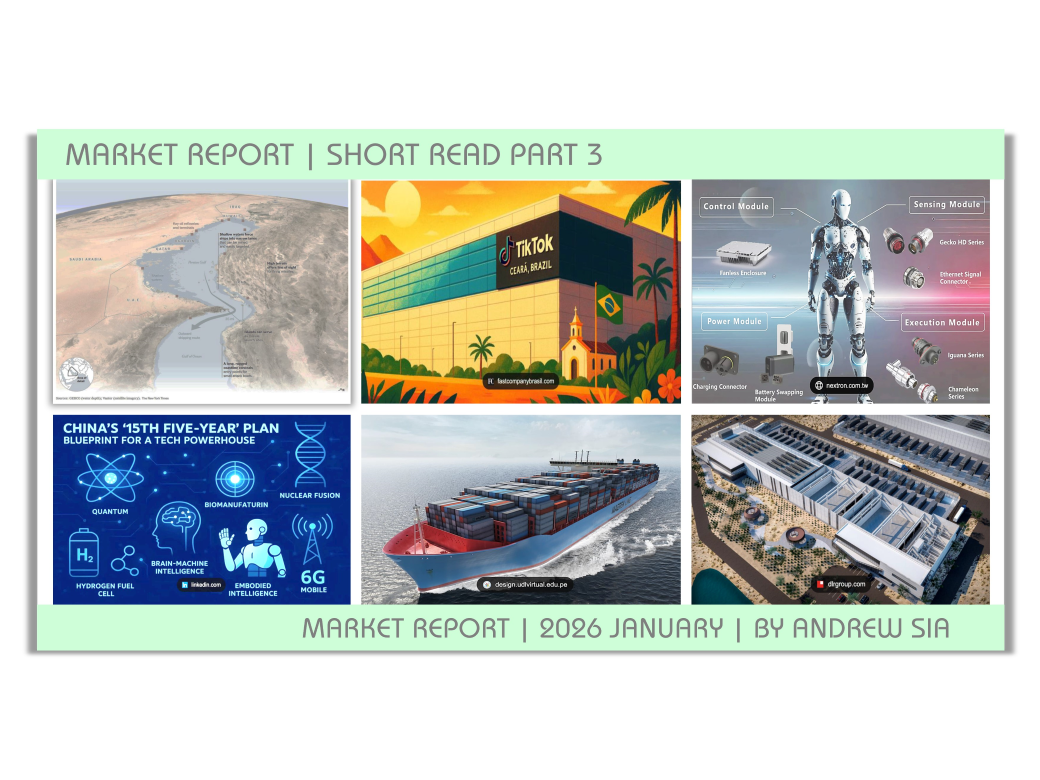
2026 JANUARY
MARKET REPORT
SHORT READ
| PART 3

Contents:
The Strait of Hormuz: A Chokepoint of the Global Economy
Germany is Facing Rising Prices and Falling Output for Energy
How Bangladesh is Faring During the Conflict in the Middle East
How to Tackle Import Tariffs from China to the U.S.?
Supply Chain in China is Facing Difficult Challenges
TikTok AI Data Center in Brazil
Data Centers in the US
Brussels Plan to Phase Out Chinese Tech from Critical Infrastructure
China’s Robot Installation is Ahead the World
China’s Industrial Policy Versus the Wishful Thinking of the U.S. Presidents
Donald Trump’s State Visit to China
What We Know About El Niño from History
Written by Andrew Sia
Share this article !
From the Desk of the Publisher

This piece has brought up some important topics. With the war still going on in Iran, and it is entering into its fourth month, and no sight of coming to terms with the U.S., Israel and Iran. This is not helping the world’s economy at all.
Germany used to be the number one industrial country is quickly sliding. We know the precision manufacturing that the Germans have been leading the world for a very long time.
We also have seen Bangladesh slipping away from the number one garment manufacturing country.
With China we made several writeups about its supply chain, its robot installation, and most important the country’s 15th Five-Year Plan.
We also come to know that from now until end of the year, Donald Trump and Xi Jinping would have three more meetings, once in the U.S., then the APEC in Shenzhen, China, and G20 in Miami, Florida. We hope that we don’t have to hold our breath in these occasions.
The last we wrote the history of El Niño which we hope that you will find it informative. We have to cross our fingers and hope that it will pass us uneventful.

The Strait of Hormuz: A Chokepoint of the Global Economy

The Strait of Hormuz has often been seen as a place of natural beauty and a quiet retreat. Expats based in Dubai would travel by road to Musandam, the part of Oman peninsula that runs into the strait’s narrowest point to enjoy its clear waters and calm surrounds. There they could fish and snorkel in the most strategically vital waterways in the world.
For decades, the strait’s safety was never challenged, especially with the United States maintaining a strong presence to ensure the uninterrupted flow of energy supplies. Its importance cannot be oversighted as it is a significant portion of the world’s oil and gas passes through this narrow passage.
About 20% of global oil and 20% of global liquified natural gas (LNG) pass through the Strait of Hormuz. This accounts for nearly a quarter of all maritime-traded oil. It was handling over 20 million barrels of petroleum and crude oil per day before the war. The political tension at the end of February when the U.S. and Israel attacked Iran, and this stopped the tankers to pass through the strait. It resulted the cutoff of the one-fifth of world’s oil and gas supply, sending the oil prices soaring and turn it into the global energy crisis.
The strait also revealed one of the world’s bottlenecks and it underlined the degree in which the world economy is dependent on a small number of geographical regions that are increasingly at risk for shutdown.
For the first time the strait has been closed since the end of February and that shows the vulnerability, especially it was since the Middle East became an important oil-producing region in the 1940s
There was the occasion during the Iran-Iraq War, took place from September 22, 1980, to August 20, 1988, where over 480 tankers were strained on one side of the strait in the Persian Gulf, while on the other side were 300 idled in the Gulf of Oman.
Throughout history, world powers have used their militaries to ensure the trade routes to stay open. And it was in 1949 that the U.S. Navy have a regular presence there.
The 1973 oil crisis revealed how dependent the United States was on the oils from the Middle East. In 1980, during the peak of the Cold War, the fear of Soviet Union invading the Persian Gulf, the U.S. President Jimmy Carter vowed that the U.S. would use force to keep oil flowing through the strait. And it became a commitment known as the Carter Doctrine. We have noticed that foreign policy has leaned toward the opening of the strait as a core U.S. interest.
During President Ronald Regan’s time, the U.S. Navy helped Kuwaiti to escort tankers through the waterway. Regan vowed that, “I’m determined our national economy will never again be held captive, that we will not return to the days of gas lines, shortage, inflation, economy dislocation and international humiliation.”
With the latest warfare between Iran, the U.S., and Israel, Joe Kent, now known as Trump’s former director of the National Counterterrorism Center, already said that the Israeli’s manipulation of the U.S. into war with Iran as they have their own agenda. Now it is going to be difficult for the U.S. to withdraw without losing its credibility in the whole matter.
We also come to know that when we are at the world’s narrow passage, wisdom, empathy, and restraint are important for those who stand at the helm.
Germany is Facing Rising Prices and Falling Output for Energy

Germany lost its main source of fuel after Russia invaded Ukraine since 2022. Since then, Germany has been aligning its flows of natural gas from Norway, and a large dependence on liquefied natural gas (LNG) from the U.S.
At this time, the natural gas prices in Europe are trading more than 70% higher than the time during pandemic, and the current war in the Middle East has only been increasing the pressure. This increase is not only affecting the consumers, but also those energy-intensive manufacturers, such as the steel mills and chemical plants. We read that the storage level of fuels in Germany has dropped from about 40% a year ago to today’s 20%.
Germany has increased terminals to store the liquefied natural gas. To keep up the demand, the country has to open up shale gas drilling and fracking to unlock oil and gas from the rocks which have been banned a decade ago. The new Chancellor Friedrich Merz’s government is more supportive to gas production, and bolstering domestic production can ease the overreliance on the U.S. for the LNG. But to obtain permits from the regulatory authorities would take years and it is extremely difficult to secure.
Oil and gas production is to end by 2045 at the latest in the international of climate protection. Operating conditions in Germany is becoming more difficult with environmental protection and carbon emissions. Growth in oil and natural gas production in Germany is unlikely. It is turning to what is known as “new energies” and there is an estimate of a significant deposit in lithium, which is a chemical used in batteries. Tapping into the earth’s core for heat and energy, such as the geothermal energy can be another option.
The biomass can be explored from organic materials, such as the agricultural residues, wood, and ethanol.
How Bangladesh is Failing During the Conflict in the Middle East – New York Times, March 17, 2026

Like other countries, Bangladesh is worried about its supply of crude oil and natural gas as access to them is getting critical especially nearly a third is coming from Qatar. The warfare has blocked the flow.
At this time, the universities are closed, and the government has imposed temporary blackouts and other means to conserve energy. This is posting a threat to Bangladesh’s export-oriented economy.
After its prime minister Sheikh Hasina was ousted by a student-led movement in August 2024, the country voted for a new prime minister, Tarique Rahman, who took power in this February. The country is still relying on a garment industry which is bringing nearly 85% of its total exports.
War in Ukraine has already increased its cost in food and fuel in 2022, and then its student movement which brought down the former regime after 15 years in power.
For the power supply, the country is over relying on gas with very little use of renewable energy. It is already use what is called load shedding, or planned blackouts, usually a couple of hours long, to reduce the strain on overburdened power stations. Most factories keep enormous diesel-powered generators to cover the down period of power. This has proved to be very costly.
Soon will come the summer months whereas the peak demand can ready 18,000 megawatts and it will turn towards the home consumption of power which can consume twice as much as all the factories combined. The thermostat will have to keep at a higher temperature.
Bangladesh is also relying on supply of diesel from India on an average of 15,000 tons each month. It has to maintain its diplomacy with its neighbor at this time.
But in Bangladesh, there is a premier industrial hub — the Dhaka Export Processing Zone — where the electricity supply is guaranteed. The zone was established in 1993, is an example of the high priority Bangladesh has given to its garment industry. To me, this kind of arrangement is a bit strange.
How to Tackle Import Tariffs from China to the U.S.?

The U.S. imposes overlapping tariffs on Chinese imports, including a base Most-Favored-Nation (MFN) rate, a 25% section 301 tariff on most manufactured goods, and temporary Section 122 global tariffs. Effective rates on most goods when added up can reach a range from 40% to 50%, or even higher, depending on the Harmonized System (HS) code.
It is already found that the average value of the products in a 20-foot container plunged nearly 40% from January 2025 to February 2026 according to data compiled by the trade date provider.
Many companies switched to new suppliers outside China to lower their tariff bill. Other choose to set up factories in Vietnam, Mexico, and other countries where import tariffs are lower.
Some companies rerouted their products through middlemen to tamper the “transshipment” which has been a practice for a long period of time when goods were under “quota” in the 1970s to 1990s until China joined the World Trade Organization.
There are other ways which are illegal practices which we would not want to publicize and elaborate. They ought to be discouraged and we hope that this loophole can be eliminated.
And then the Chinese companies offered a service known as “delivered duty paid” or DDP, of which the importers only paid when the goods are delivered to their hands in the American soil. Importers have nothing to worry about the true cost and the tariffs as they don’t get to see the paperwork, but only to pay for the price on goods that are delivered into their hands.
The U.S. governments have to blame themselves for introducing the import tariffs abruptly without thinking and drafting out the rules more thoroughly. The importers are caught under the tsunami, and some would have gone under as they were unable to react and turn their business around.
At the same time, we found the retaliatory tariffs Chinese customs apply on U.S. imported goods can often reach from 34% to 84% depending on recent trade negotiations.
Also, the de minimis exemption for duty-free entry for packages valued under $800 which the U.S. has suspended this exemption for China and Hong Kong.
On the other hand, China granted preferential or zero-tariff to dozens of Least Developed Countries (LDCs) and operates twenty-four Free Trade Agreements with various trading partners worldwide.
Supply Chain in China is Facing Difficult Challenges – New York Times, April 20, 2026

There is this severe housing downturn that has left China’s economy heavily depend on a trade surplus narrowed $265 billion in the first three months of the year due to the cost of importation of oil rose.
There are also these tariffs imposed by Trump that have caused the pressure for China’s export.
In order for China to overturn this situation, it has tried to legislate 18-point regulations, and basically it is to pass a law to investigate and punish foreign companies who stop using Chinese suppliers in response to political pressure at home. Analysts already warned that the regulations could make it harder for foreign companies to move away from their joint ventures in China, or to move their orders to other suppliers. This is Beijing’s broader effort to counter what it sees as rising protectionism in the West which was driven by a surge in Chinese exports and growing concerns about trade imbalances. Actually, China’s exports exceeded imports by almost $1.2 trillion last year and it was also when Trump started to apply his tariff policy.
China’s manufacturing dominance nearly every industry sectors. Lately many foreign companies are reducing their dependence on China and foreign automakers have closed factories, except Volkswagen who is expanding. The new rules were signed by Chinese Premium Li Qiang in mid-April which further allowed its regulators to bar companies and individuals from leaving China if they are suspected to move supply chains elsewhere.
Earlier on, foreign companies were avoiding goods from northwest China’s Xinjiang region where it was cited for evidence of force labor, mass arrests and confinement to re-education camps targeting the area’s Muslim Uyghur population.
Take car sales in China as an example as the sales have plunged 17.4% so far this year due to its domestic economy. Automakers turn their business to export, and car exports soared 50.3% in the first three months this year. This surge has caused rising concerns in the West about job losses and in developing countries like Malaysia, Mexico and Brazil.
We have not to forget China imposed strict export controls on rare-earth metals and magnets, which are essential to a wide range of industries. The European Union Chamber of Commerce in China protested strongly particularly about the control of the rare-earth export which is affecting a wide range of industries.
The world is really facing a very complicate situation to solve and to overcome before we can make it harmonizing again. The spirit of free trade has been shattered.
TikTok’s AI Data Center in Brazil – FT, April 30, 2026

In a semi-arid area with a history of drought where the indigenous people are dwelling In Amazon, TikTok has a plan for a $9.5 billion AI data center. This will also be its Chinese parent company, ByteDance’s first site in Latin America.
Data center is already becoming very controversial because of its environmental demands on land, water, and electricity. This time it has caught the protest from the indigenous people questioning the project’s sustainability in a semi-arid area and is also suffering from drought.
This data center will need 300-megawatt electricity consumption which is equivalent to a medium-sizes power station, will be met entirely by new wind farms and schedule to come online by late next year. It will be the first hyperscale operation that can support Cloud services and AI.
This project in Brazil is going to be China’s opportunity to develop its diplomatic and economic influence. We have to know that the future economy is the digital economy and China is getting itself ready.
The facility is in the municipality of Caucasia, and it is going to be the first of several data centers at the 35-hectare site, equivalent to 50 football fields. It is an investment of $38 billion by 2035. It will bring 4,000 permanent and temporary jobs. For a state of Cearà, which is the country’s poorer north-east controlled by organized crime, can probably become an opportunity to improve the people’s livelihood.
The nearby population is protesting for unreliable water and electricity supplies. Their worry that it would get worse before it could get better.
Total water for the first phase of the data center will be 30,000 liters per day and there will be a refrigeration system that recirculates water. The water will be drawn from an on-site well, and only one-tenth will be used for cooling, and the rest for the building and the people’s use. The use of the wind farm for electricity is to ensure that the operation doesn’t compete for existing power grid sources.
Brazil has significant expansion of wind and solar power, but it is out of proportion with the grid with its excess generation especially in its north-east region. The project from TikTok crated a lot of finger-pointing between the activists and the government.
Questions about the compliance of environmental norms, security concerns as Chinese digital infrastructure could contain “back-doors” for its intelligence services. China is hoping for its expansion of its global tech influences, but the locals are skeptical about the benefits of such infrastructure could bring to its economy and people.
Data Centers in the US – FT, April 28, 2026

Data centers once were only clustered around cities and towns, are moving into farm country in search of cheaper land and tax incentives. In these days 67% of the planned data centers are in rural areas, which 87% of the existing data centers are still in urban areas. More than 160 new AI-focused data centers have been built across the U.S. in the past three years, a roughly 70% increase on the total.
As the industry has expanded, public opinions have viewed data centers as harmful than beneficial in terms of environmental impact, domestic energy costs and quality of life in nearby communities.
This issue has become awkward for Trump and his Republican Party as the administration support for AI could trigger a backlash among key voter blocs, where the farming communities represented around 78% of the U.S. counties dependent on agriculture voted for him in 2024.
As usual, those rural communities, along with many Americans, worry about the immediate impact of data centers as often they never disclose the detailed water plans. Typical is the example of the Sierra Club in West Virginia where four data centers will be built. They intended to use their own gas-fired plants raising further concerns about air pollution.
Farmers are tempted to lease their land to the use of data centers and infrastructures that will come along. We are talking about income of the multiple of ten times in exchange for the yields of crops like corns for instance.
Already researchers are forecasting the so called hyperscale data centers will consume anywhere between 16 billion gallons to 33 billion gallons of water on-site each year in 2028. The data center operators are arguing that the “closed loop” system can pump coolant through pipes to dissipate heat from servers rather than evaporating water as in the past. Nividia is saying that they have developed more energy-efficient chips that require less cooling.
According to the Department of Energy, roughly 100 gigawatts of additional electricity capacity will be needed by 2030. This will lead us to look deeper into this matter and another writeup in our Special Report will have a deep analysis to bring us more to the speed of this what I would label it as the “Gold Rush” for the AI.
Brussels Plans to Phase Out Chinese Tech from Critical Infrastructure

Brussels is proposing to phase out Chinese-made equipment from critical infrastructure in the EU, especially from companies like Huawei and ZTE from telecommunications networks, solar energy systems, and security scanners. This move comes as the EU is planning to revamp its technology policy and national security on its dependency on big U.S. tech companies, as well as Chinese high-risk suppliers who could have used to collect its sensitive data.
EU’s solutions for security measures on its infrastructure have been fragmented, and in many cases, it was found that individual countries within the EU could have signed agreements with Huawei and ZTE and other hi-tech companies separately. Its Cybersecurity Act is still subject to change. This has added extra workload for the European Commission to implement and to launch probes into its fast-train system, and wind turbines.
To keep the timeline for the phase out would also risk the cost increase and also the availability of alternative suppliers. The European Commission prepared the draft for negotiation with the European Parliament, and EU countries are faced with some resistance.
So far, some companies are able to move away from the Chinese technology, such as:
– Sweden effectively banned Huawei from 5G
– UK ordered telecom operators to remove Huawei gears
– Germany began to restrict and replace Chinese telecom equipment in sensitive parts of networks
Countries who were reacting slower because of following reasons:
– Telecom operators are already heavily depended on Huawei equipment
– High cost of replacement
– Concern of the trade relationship with China
With the latest cybersecurity legislation, EU is trying to make the restrictions more binding through revisions. The proposed rules would require telecom operators to phase out equipment from high-risk suppliers with set timelines.
There is a broader geopolitical shift behind all these, and European countries are increasingly worried about their dependence on:
– Chinese telecom infrastructure
– S. Cloud dominance
– Semiconductor supply chains
– Cyber vulnerabilities in general
This is becoming a wider strategic autonomy for EU and it not only about Huawei for instance.
As usual Beijing commented about the European Commission push to phase out the use of Huawei and ZTE technology would violate market principles and the rules of fair competition.
China’s Robot Installation is Ahead the World

China installed nearly 300,000 industrial robots in 2024—more than all other countries combined. Japan ranked a distant second with roughly 44,000 installations, while the U.S. followed with about 34,000 robots from the working on assembling lines and packing and lifting boxes onto conveyor belts.
China is leading on robots and other advanced technologies in semiconductors and artificial intelligence. It is also a major maker of robots. With this advantage, it is making nearly a third of all manufactured goods worldwide. This is more than the U.S. Germany, Japan, South Korea, and Britain combined.
Worldwide, where robots and artificial intelligence are playing an important role in manufacturing.
China, through its “Made in China 2025” campaign, has benefited from loans provided by the state-controlled banks at lower interest rates. Direct infusion of capital has also helped in expanding its industries. The government’s support has led to a boom for start-ups making humanoid robots. The humanoid robot is selling at $6,000 in China which is a fraction of the price of robots made by the U.S. robot maker.
China has multiple advantages in making robots as it has large numbers of skilled electricians and specialized computer programmers who can install robots. It is using its artificial intelligence industry to apply the new technologies on track and improve every aspect of factory equipment for improving its performance. In this aspect, China is ahead of all the competitions.
China’s Industrial Policy Versus the Wishful Thinking of the U.S. Presidents – WSJ, May 16, 2026

Since China joined the WTO, the U.S. presidents have traveled to China and took along a predicted list of items with conditions that China shouldn’t steal intellectual property, don’t force technological transfer, and ask for China to open the market for the Western world.
With the most recent Trump’s visit to China and based on the last report we read that China agreed to purchase about 200 Boeing commercial jets, with the possibility that it could eventually expand to as many as 750 aircrafts. It is expected to be mainly Boeing 737 MAX jets. We have to know that China had stopped major Boeing purchases for nearly a decade due to trade tensions and safety disputes. During the time, Airbus had gained the major market supply.
Aside of the purchasing of aircrafts, China is showing interest in increasing imports of US oil, liquefied natural gas (LNG), and agricultural commodities, such as soyabeans.
For technology and AI, some restrictions on technology transfer, semiconductor access, and expanding market access for certain U.S. technology companies.
That was the list from the U.S. side with the wishful thinking which could end up being pointless. This time China has reevaluated China’s industrial policy and scarily enough, it has targeted almost every industry, its demand and supply, and its services and goods. Its goals are covering economic, technological and strategic. China is going after macroeconomics. It is no longer the China the West know of.
Many Chinese products have matched and beat Western competitors on price and quality. It has just completed the country’s five-year plan issued in 2021 and it is now releasing its 15th Five-Year Plan, which is covering 2026 to 2030.
We can refer to China’s twenty-four areas of this 5-year plan in its strategic priority sectors as the following:
Digital & Advanced Technology
- Artificial Intelligence
- Semiconductors/Integrated Circuits
- Quantum Computing
- Cloud Computing and Big Data
- 6G/Advanced Telecommunications
- Cybersecurity
- Robotic and Automation
- Industrial Software and Smart Manufacturing
Advanced Manufacturing
- Aerospace Equipment
- Commercial Aviation
- High-Speed Rail Systems
- Maritime Engineering and High-Tech Ships
- Advanced Machine Tools
- Industrial Machinery
Energy & Environment
- Electric Vehicles (EV)
- Hydrogen Energy
- Nuclear Energy
- Renewable Energy – Solar/Wind
- Energy Storage & Batteries
- Smart Grid Infrastructure
- Carbon Reduction & Green Technology
Materials & Life Sciences
- Advanced Materials & Rare Earths
- Biotechnology & Biomanufacturing
- Medical Technology & Pharmaceuticals
This list has paled Trump’s list of what China should buy from the U.S. This pervasive nature of China’s industrial policy makes it harder for any competitors to counter. Trump’s tariff policy has driven down the U.S. trade deficit with China, but China has redirect exports to other markets. We also noticed that Chinese inputs are omnipresent in global supply chains and the value of Chinese content entering into the U.S. have remained unchanged even as direct imports dropped.
Although the U.S. has called for a joint response by all market-based democracies to Chinese industrial policy, the U.S. allies’ willingness to coordinate with the U.S. on China has eroded under Trump.
We may criticize Chinese industrial policy for its cost and waste as China runs bigger budget deficits relative to economic output than the U.S. Its economy may fail by debt, inflation, and aging demographics, and the Chinese industrial policy may eventually implode under the weight of its own contradictions. But we think that China can stay irrational longer than the western competitors can stay solvent even if it has a tall order in front of itself.
Donald Trump’s State Visit to China
Trump’s state visit to China took place from May 13 to 15, 2026. Based on the latest report, China appears to be purchasing 200 Boeing commercial jets, with the possibility that it could eventually expand to as many as 750 aircrafts. It is expected to be mainly Boeing 737 MAX jets. We have to know that China had stopped major Boeing purchases for nearly a decade due to trade tensions and safety disputes. During the time, Airbus had gained the major market supply.
Aside of the purchasing of the aircrafts, China is showing interest in increasing imports of US oil, liquefied natural gas (LNG), and agricultural commodities, such as soyabeans.
For technology and AI, some restrictions have slightly eased on technology trade, semiconductor access, and market access for certain U.S. technology companies have been expanded.
It is interesting to know now how many of the above has been realized, especially the number of Boeing commercial jets been placed.
Apparently, the Chinese purchasing pattern is highly strategic, and we can highlight the following areas:
– Boeing – for the support of China’s aviation modernization
– LNG and oil – for energy security
– Soybeans and grains – for food security
– Chips and AI – for technological survival
– Industrial software – for manufacturing competitiveness
Many analysts believe the modern US—China relationship is no longer a normal trade relationship. It has become a competition for industrial leadership which can lead to technological dominance, and long-term economic resilience.
It is no longer the “panda diplomacy” that China used to play until the last decade. It has not been moving to “strategical supply-chain diplomacy.”
It has been said that there will be three more meetings between Donald Trump and Xi Jinping for this year. There is the state visit of Xi in Washington DC from September 24 to 25. Then there is the APEC in Shenzhen from November 18 to 19. The last meeting will be the G20 Leaders’ Summit to be held in Miami, Florida of which the U.S. will be the host. It is likely that the Russian President Putin may attend.
What We Know About El Niño from History – New York Times, May 21, 2026
Do you know El Niño was named after Peruvians, who had noticed that sometimes tropical fish would unexpectedly show up on their shores around Christmas. It is a phenomenon they eventually named “El Niño” or “Christ Child” in Spanish. It is actually the warming up of the water in Pacific Ocean that change the weather patterns around the world.
El Niño is the name given to the powerful shifts in Pacific Ocean winds and water temperatures that can drastically transform global weather patterns. Over the centuries, we have seen these natural patterns have sparked epic droughts and heat waves and have also intensified epidemics.
We can find El Niño on political and economic crisis in ancient Egypt, and on the downfall of Moche civilization in present-day Peru in more than 1,000 years ago. It was in 1877 and 1878, a famine caused by El Niño killed millions of people across the tropics.
This time, the world is entering into a new El Niño era, and already researchers are warning that it could be one of the strongest weather changes that can be recorded in history for its natural forces when they can reach their highest magnitude. It can also lead to profound volatility and hardship.
In general, El Niño can make wetter conditions in some part of the Americas while suppressing the Atlantic hurricane season, but the phenoxenium raises the risk of dryness in South and Southeast Asia, Australia, and southern Africa.
This El Niño as we know is still in the early stages of its formation and might not live up to the hype. But if the forecasts prove to be accurate, then it would be a whopper and its consequences would play out across the world which could become more resilient in this time, and yet it has its new vulnerabilities.
Today our agriculture is far more sophisticated than a century ago, and countries that are vulnerable to harvest would have hold strategic grain reserves. Large-scale famine would not have happened.
Currently we have fertilizer shortages caused by geopolitical reason as the Strait of Hormuz has been closed. On the other hand, the war in Ukraine and Iran both increased the oil price that have caused all kinds of financial pressure to the world. We have noticed that this has weaken the foreign aid to poorer countries.
In a moderate El Niño, temperature might climb 1° Celsius above average. But in the past 50 years, the one started in 1982, 1997 and 2015, temperature rose to 2° Celsius or more beyond the norm. And each time they have caused a global economic toll.
This time many forecasters are saying that the temperature could increase by an unprecedented 3° Celsius. Even the 1877 El Niño didn’t reach that magnitude. Also, this time, the global temperature on land in the months that follow would cause 2027 to be the warmest year on record.

I bring you also another weather phenomenon—La Niña which can transit from El Niño, and forecasters have been watching closely as La Niña can absolutely affect weather in the U.S. including the Northeast, although its influence is usually stronger in some regions that others.
Here is the basic cycle:
– El Niño is usually warm surface waters in the central/eastern Pacific
– La Niña is usually cool waters in the same region
Typical El Niño develops, then it weakens, and sometimes the climate system flips into La Niña afterwards. But this doesn’t happen as a rule, some years it returns to neutral condition instead.
This year the forecasters are watching closely whether the recent El Niño would transit into La Niña, and this transition can influence us with:
– Hurricane activities
– Winter storms
– Rainfall patterns
– Temperature trends
La Niña is known to affect the U.S. in the following areas:
– Wetter and cooler conditions to the Pacific Northwest
– Warmer and dried weather across the southern U.S.
– A more active Atlantic hurricane season as upper-level winds over the Atlantic can be less disruptive to storm formation
In the Northeast region, including New Jersey, the effects are less predictable, but La Niña winters can bring:
– More temperature swings
– Occasional colder outbreaks
– Storm can still produce significant snow events
We have to know that climate patterns are generally influenced by long-term global warming, so the El Niño-Southern Oscillation effects today may not always behave exactly like the older historical averages.