
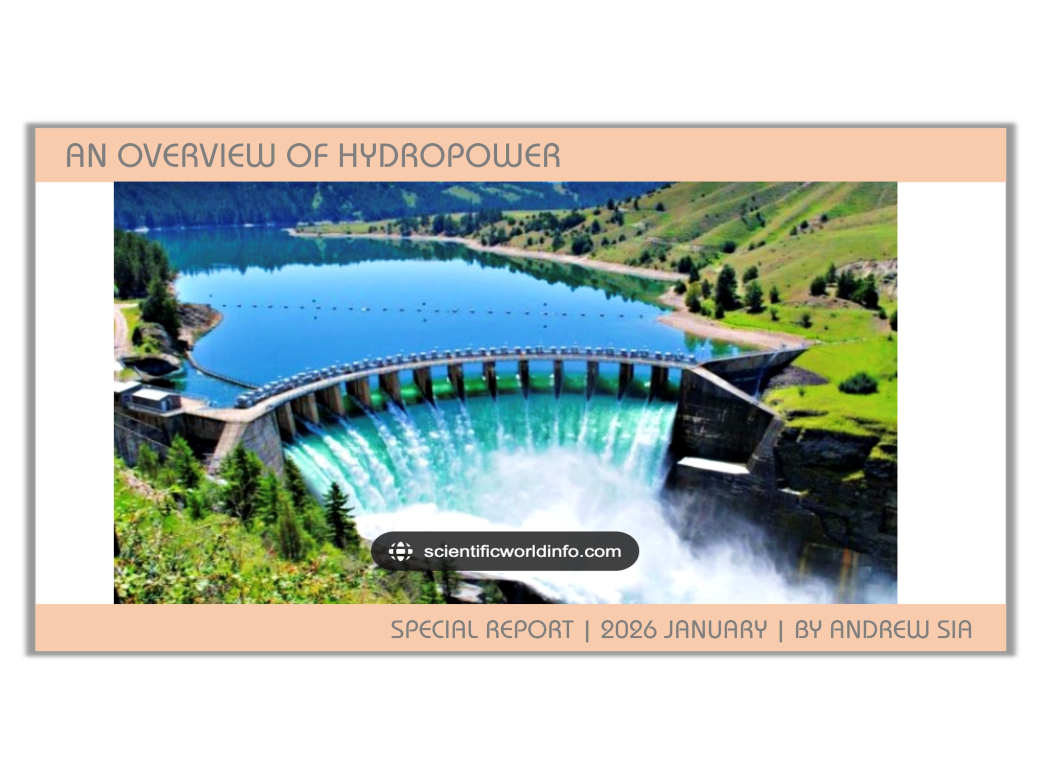
2026 JANUARY
AN OVERVIEW OF
HYDROPOWER

Written by ANDREW SIA
Share this article !
From the Desk of the Publisher

The piece opened by pointing to the drop of hydropower due to the extreme weather. It resulted more governments are rushing to build more dams. China is building the world’s largest hydropower project in Tibet, and it raises concerns from India and Bangladesh as it is taking the water flowing from Tibet to their rivers, India’s Brahmaputra, and Bangladesh’s Jamuna.
There is also the situation in Brazil where it is affecting the Amazon.
But hydropower is affected by climate condition. Its project impedes rivers, endanger wildlife, cause deforestation, and drive out indigenous inhabitants. Its further development may sound ambiguous in some cases.
To sum up energy sources globally we can look at the following:
Oil – 30%
Coal – 26%
Natural gas – 24%
Hydropower – 6%
Nuclear – 4%
Wind – 4%
Solar – 3%
Bioenergy – 3%
Fossil fuels altogether still supply about 80% of global energy. We have not to forget that for electricity, it is only accounted for 20% of energy use. Transport, heating, and industry are accounted for 80%. We ought to know about this very important knowledge.

Hydropower is the world’s third largest source of electricity after coal and natural gas. But it is becoming less reliable since 2013 as electricity produced by hydropower dropped by the equivalent of the power consumed by Chile or the Philippines. It is caused by the extreme weather.
Despite challenges over the environmental and social concerns about dams, some governments and energy companies are pushing to build more dams.
China is working on the world’s largest hydropower project in Tibet, raising concerns about water capacity in India and Bangladesh. Its massive new dam project in Tibet, the Medog Hydropower station on the Yarlung Tsangpo River, is designed to be significantly larger than the Three Gorges Dam, aiming for roughly three times the annual output, around 300 billion kWh, and an installed capacity of 60-80 gigawatts, making it the world’s largest hydropower facility. While Three Gorges is currently the world’s largest by installed capacity, with the planned Tibetan cascade system, it surpassed all the capacity. The investment is over $160 billion, making it one of the world’s largest infrastructure projects. The project raises environmental and strategic concerns for downstream nations for their rivers, like India’s Brahmaputra, and for Bangladesh’s Jamuna, impacting water flow and ecosystems.
Brazil has the third-largest river basin deep in the Amazon basin, and a massive hydroelectric power plant stands as the world’s oldest source of clean energy, but it is facing the massive challenge. Drought and time have taken their toll on the dam as visitors can see leaks that form little and unwanted waterfalls.
The Tucurui Dam completed around 40 years and together with hundreds of others scattered around the world are coming under pressure as droughts made it hard for the dams to generate enough energy. But too much rain can cause damage to their equipment.
Hydro energy production fell 3% in Brazil last year. Canada, China, and the United States have also struggled with low hydroelectric production in recent years. How to make up for those shortfalls while achieving ambitious emissions and economic goals have been on the agenda at the United Nations’ annual climate conference in Belém, a six-hour drive from Tucurui.
Tucurui is the third-largest electricity generator in Brazil and the eighth in the world. So that we know, Itaipu Dam, the largest power plant, is a binational project located on the Paraná River on the border with Paraguay. It has a total installed capacity of 14,000 MW, shared equally between the two countries. Belo Monte HPP, is the largest hydroelectric plant located entirely within Brazilian territory, located on the Xingu River. It has the installed capacity of 11,233 megawatt. The Tucurui Dam has an installed capacity of 8,370 megawatt, made it the third largest in Brazil.
Extreme weather has hit Brazil hard. In 2014 and early 2015, the country nearly had to ration electricity because some reservoirs were running low. Drought and deforestation in the Amazon rainforest caused low water levels. Wildfires destroyed an area in Amazon as big as California. This has all to do with the climate change.
The owners of Tucurui are spending $270 million to modernize the 40-year-old dam with what the age and weather have inflicted on it. Brazil is also increasing its use of wind turbines and solar panels as hydroelectric power has become more erratic. These two sources provided more than a third of the nation’s electricity for the first time.
Hydropower plants are marvels of engineering, not only because they are large, but also their gigantic structures often rise above rivers in remote and environmentally sensitive places.
Critics, including many environmental groups, have long argued that hydroelectric projects impede rivers, endanger wildlife and cause deforestation, and drive out indigenous inhabitants. Conflict over hydro power exist around the world and there are roughly 600 million people worldwide without access to electricity. On the other hand, the world would need twice as much hydropower by 2050 as it had now, though we already know reaching that goal is impossible.
It has also been a long struggle, and we need technology desperately to help us. But hydropower has been coming along for a very long time, and we are still behind the demand. We have seen the coming up of the data centers, and now we are talking about the quantum computer which is draining our electricity faster than we can produce. We have to sit down and think for the workable strategy.
