
2025 JULY ISSUE
THE RISE & FALL OF
AMERICAN
DEPARTMENT STORES
PART 5

Written by TERRI FISHER
Share this article !
From the Desk of the Publisher

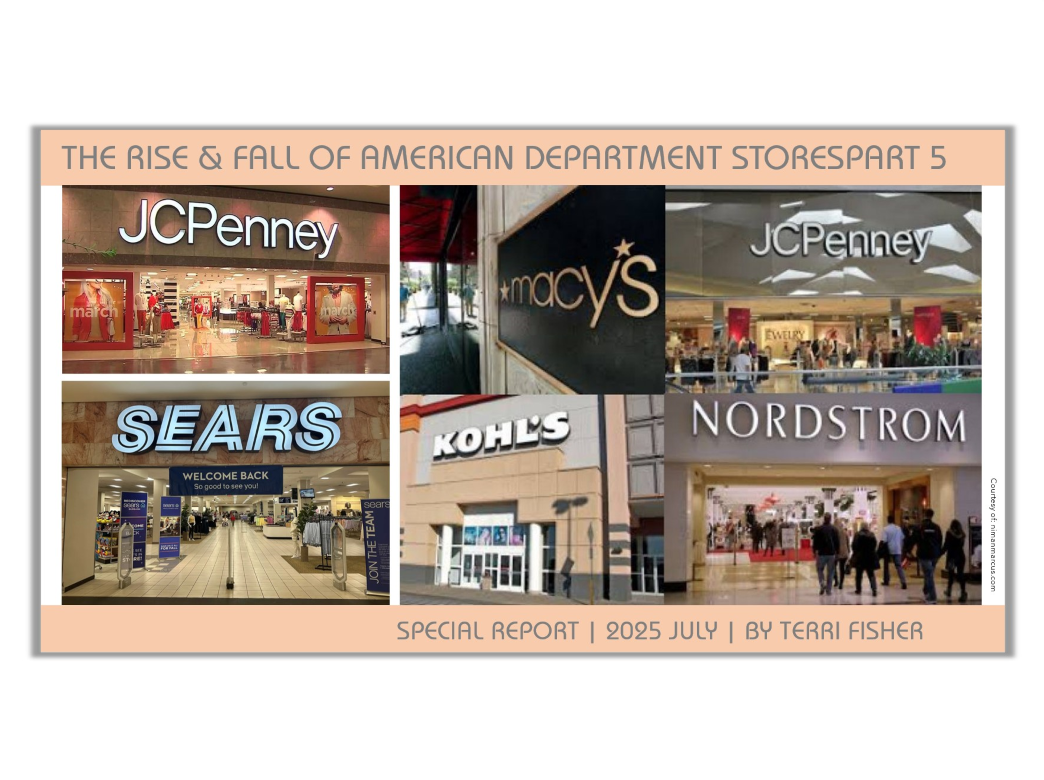
This is the last part of our retail correspondent, Terri Fisher’s report. We are coming to the reports of the JCPenney and Sears.
JCP is known as the American wardrobe. At its primetime it had 1,100 stores. Today, its store-traffic plunge to 40% before its pandemic level. Its bankruptcy and restructure don’t help. Its debts stand at $4 billion. Closure of JCPenney store in the shopping mall is like killing the community and all the smaller businesses were closed as it has brought along the domino effect.
Sears shares the saddest story as its remaining stores as of mid-2025 is reported to have 8-full-line stores remaining in the U.S. although the number can be less. Imagine in 2013 Sears and Kmart combined, they had 2,400 stores. Today you can only find them in very few states: California, Florida and Massachusetts. It just closed its last store in Puerto Rico.
Its operations have reduced from a broad merchandise line to home services, appliances, tools, parts, and repair services. It is losing competition to online, discounter, and fast-fashion the changing of consumer expectations has made the large-store model very challenging.


The Rise and Fall of J.C. Penney
Executive Summary
J.C. Penney Company, Inc. (JCPenney) stands as one of the most recognizable names in American retail. Founded in 1902, it grew into a national department-store powerhouse before declining due to online competition and strategic missteps. After filing for bankruptcy in 2020, the company emerged under Simon Property Group and Brookfield Asset Management, now focusing on modernization and profitability.
Company Overview
Founded: 1902 in Kemmerer,
Wyoming Founder: James Cash Penney Headquarters: Plano, Texas
Ownership: Privately held by Simon Property Group & Brookfield Asset Management Industry: Retail — Department Stores
Number of Stores (2025): ~650 Employees: ~50,000
Estimated Revenue (2024): $7–8 billion
Historical Overview
From its humble beginnings as a ‘Golden Rule’ store, J.C. Penney became a household name across America by the 1950s. It peaked as a mid-market retail leader with over 1,000 stores by 1928 and later dominated shopping malls nationwide. However, online retail disruption and leadership instability in the 2010s led to declining sales and market share.
Post-Bankruptcy Restructuring
In 2020, J.C. Penney filed for Chapter 11 bankruptcy and was acquired by Simon Property Group and Brookfield Asset Management. The restructuring included closing 200+ stores, reducing debt, and focusing on efficiency and private-label growth.
Financial Overview
J.C. Penney’s estimated annual revenue fell from $11.7 billion in 2018 to $7.9 billion in 2023. The company is now smaller but operating more efficiently, with modest profitability due to reduced debt and improved cost management.

Strategic Focus (2023–2025)
J.C. Penney is reinvesting $1 billion into store modernization, digital platforms, and merchandise updates. Key areas include omnichannel integration, beauty category expansion, and operational efficiency.
Competitive Landscape
J.C. Penney competes with Macy’s, Kohl’s, and Dillard’s, as well as value retailers like Walmart, Target, and TJ Maxx. Its future depends on capturing value-conscious customers while differentiating through service and private brands.
SWOT Analysis
Strengths: Legacy brand, nationwide presence, loyal customer base.
Weaknesses: Aging brand perception, limited differentiation.
Opportunities: Digital growth, mall partnerships.
Threats: Mall decline, inflation, online competition.
Conclusion
J.C. Penney’s history reflects the broader evolution of U.S. retail. With renewed investment and a streamlined strategy, the company seeks stability and gradual revival. Success will depend on modernization, customer engagement, and operational discipline.

The Rise and Fall of Sears: A Retail Giant's Legacy
Sears, Roebuck and Company, once an undisputed titan of American retail, holds a complex and compelling place in the nation’s economic and social history. From its humble beginnings as a mail-order watch company in the late 19th century to its peak as a sprawling empire encompassing department stores, financial services, and even real estate, Sears was synonymous with the American dream for generations of consumers.
Founded in 1886 by Richard Warren Sears, the company quickly diversified, offering a vast array of goods from agricultural equipment to household appliances through its iconic catalog. This innovative approach allowed rural Americans to access products previously available only in urban centers, fundamentally changing the landscape of commerce. The catalog became a staple in millions of homes, serving as a wish book, a practical shopping guide, and a source of entertainment.
The mid-20th century saw Sears expand into brick-and-mortar stores, becoming a dominant force in suburban malls across the country. Its product lines, including popular brands like Kenmore appliances and Craftsman tools, became household names, revered for their quality and reliability. Sears was more than just a store; it was a cultural institution, a place where families shopped for everything from clothes to cars, and where many Americans got their first taste of credit through its store cards.
However, the late 20th and early 21st centuries proved to be a challenging period for the retail giant. A combination of factors, including the rise of discount retailers like Walmart, the emergence of e-commerce, and a series of strategic missteps, began to erode Sears’ market share and profitability. The company struggled to adapt to changing consumer preferences, failing to modernize its stores and embrace digital commerce with the same agility as its competitors.
Despite attempts at revitalization, including the acquisition of Kmart in 2005, Sears continued its decline. Store closures became a common occurrence, and its once-dominant brands lost their luster. The company filed for bankruptcy in 2018, a somber moment that marked the end of an era for many.
The story of Sears is a powerful lesson in the ever-evolving nature of retail and the challenges even the most established companies face in an increasingly competitive marketplace. While its physical footprint has diminished, the legacy of Sears lives on in the memories of generations who grew up with its catalogs and stores, and in the fundamental changes it brought to how Americans shop.
Financial Performance
Sears’ financial performance over its later years reflected its struggle to adapt. Revenue steadily declined, operating losses mounted, and its once-strong asset base dwindled.

Product Categories
Historically, Sears offered an incredibly diverse range of products, catering to nearly every aspect of American life.
- Appliances: Kenmore (refrigerators, washers, dryers, stoves)
- Tools: Craftsman (hand tools, power tools, lawn and garden equipment)
- Automotive: DieHard (batteries), auto parts, repair services
- Clothing & Accessories: Apparel for men, women, and children; footwear, jewelry
- Home Goods: Furniture, mattresses, home decor, electronics, sporting goods
- Building Materials: Lumber, hardware, paint (especially in earlier catalog days)
- Financial Services: Sears credit cards, insurance, home improvement financing
- Other: Toys, health and beauty products, agricultural equipment (historically)
Inventory Strategies
Sears employed various inventory strategies throughout its history, evolving with the company’s growth and the changing retail landscape.
- Early Catalog Era: In its early days, Sears largely relied on a centralized warehousing model to support its catalog business. Goods were stored in massive distribution centers and shipped directly to customers or to local catalog sales offices. This allowed for a wide selection of products without the need for extensive physical store inventory.
- Expansion to Brick-and-Mortar: As Sears transitioned to department stores, its inventory strategy became more complex. Each store maintained its own inventory, typically stocked based on local demand and regional preferences. Centralized purchasing and distribution still played a crucial role in supplying the stores with core merchandise.
- Just-in-Time (JIT) and Supply Chain Management: In later decades, like many retailers, Sears attempted to implement more modern inventory management techniques, including just-in-time (JIT) inventory systems to reduce carrying costs and improve efficiency. This involved closer collaboration with suppliers and more sophisticated forecasting tools. However, the sheer scale of Sears’ operations and its diverse product offerings made a truly lean inventory system challenging to fully implement across its entire enterprise.
- Challenges and Missteps: One of the significant challenges Sears faced in its later years was inefficient inventory management. Stores often had excess inventory of slow-moving items, while popular products were out of stock. This led to markdowns, reduced profitability, and frustrated customers. The company struggled to integrate its online and in-store inventory systems effectively, further hindering its ability to optimize stock levels and fulfill orders efficiently.
Conclusions
The ultimate failure of Sears can be attributed to a confluence of factors, primarily its inability to adapt to fundamental shifts in the retail landscape. Key among these were the rapid ascent of e-commerce, which Sears was slow to embrace and integrate effectively, and the intense competition from discount retailers that offered lower prices and more streamlined shopping experiences. Strategic missteps, including a lack of investment in modernizing its physical stores, a failure to innovate its product offerings, and often inefficient inventory management, further exacerbated its decline. While Sears once thrived by catering to a broad market with a diverse catalog and subsequently through its widespread department stores, it ultimately lost relevance by failing to meet evolving consumer expectations for convenience, value, and a seamless shopping experience. The legacy of Sears serves as a stark reminder that even established giants must continuously evolve to survive in a dynamic marketplace.
Please let us know if there were any report for any additional stores that you would like us to report on. Feel free to email me at terri@internationalappareljournal.com

Terri Fisher
Retail Correspondent
terri@iappareljournal.com