
2025 January ISSUE
HIDDEN COST OF
FAST FASHION
(CHEAP CLOTHES HIGH COST)

Written by ANDREW SIA
Share this article !
From the Desk of the Publisher

Fast fashion has brought convenience and affordability, but on the other hand it causes harm across multiple areas—environmental, social, and economic.
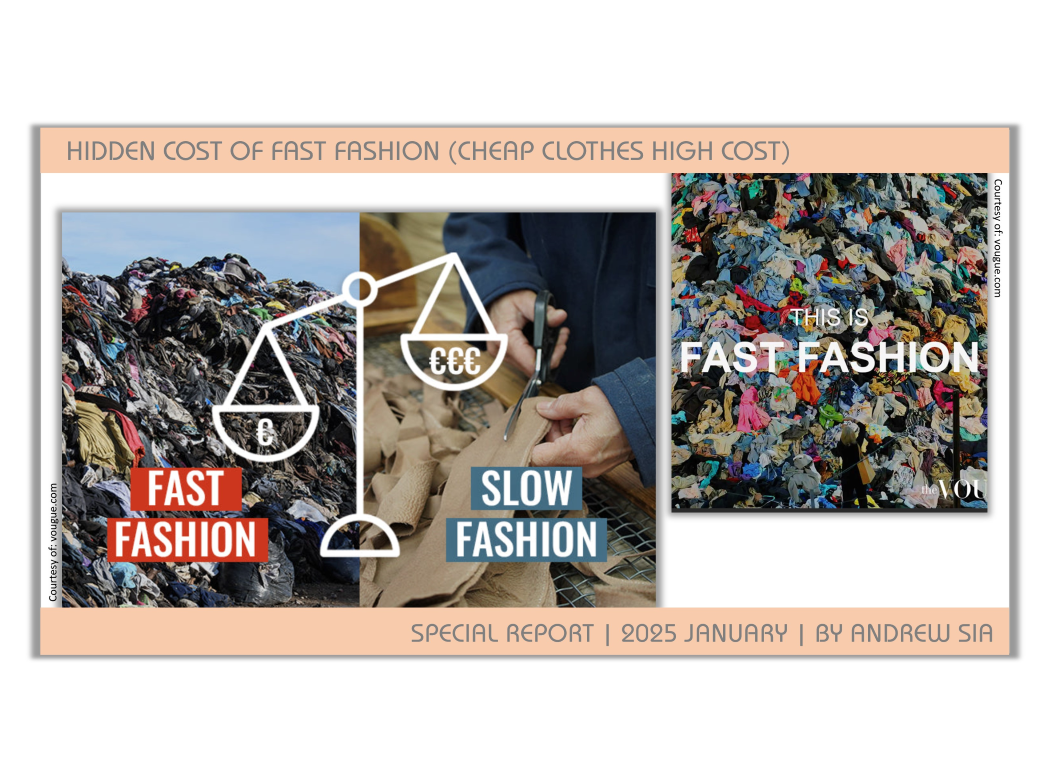
It created an estimated 92 million tons of textile waste a year. Its discharge from dyeing and processing fabrics using chemical causing environmental problems. Some synthetic fibers, like polyester, release microplastics into waterway when washed, harming marine life.
Productions are mainly carried out in low labor cost countries, under paying the workforce, creating unethical practices, child labor, and continuing poverty in the developing countries.
Since the emerging of the e-commerce giants, Shein and Temu, they are overtaking the first group of fast fashion operators like Zara, H&M, and Uniqlo. They trade down with lower prices and faster market reaction.
We must do something here to try to turn the situation around.

Fast fashion emerged in the 1990s when European retailers such as Zara and H&M started to introduce them. The idea for quick changes for the fashion seasons for collections that are launched every month has changed the buying habit for the young consumers. Normally, a traditional fashion retailers may offer 1,000 styles a year, fast fashion brands release up to 20,000 a year. They operate successfully by keeping inventory low, use analytic report for data allow them to understand customers’ need. From the production line, they use “just-in-time” management to quickly churn out most salable clothes. Although they price their garments with low prices, because of the quick turnaround of inventory that led them for higher sales volume and more profit margin than traditional fashion retailers.
The first generation of fast fashion retailers are outpaced and underpriced by Chinese online retailers, being Temu and Shein, the two most well-known, and each ship roughly 1 million packages a day to the U.S. customers directly. It revolutionized the practice of the traditional retailers who receive foreign-made goods in bulk in their warehouses which also operate as distribution centers. From there they deliver to the retail shops where the shoppers would visit and shop their items.
Social media is filled with videos from Shein and Temu from influencers and daily users who are showing off their “treasure hunts” that make their products more popular with the low-price apparel. It is becoming a cult, and these cloths would only be worn not more than 6 times, and every five items produced, three end up in landfills or being incinerated. The secondhand markets are so overwhelmed with clothes being dump rather than taken up by someone. The wearers are discarding their clothes as they have appeared in the social media as something uncool already.
We have to learn to react to the market in these days especially we are now under the competitions from every direction. Applying the artificial intelligence can help us to go through social media platforms, online shopping sites, international fashion shows, and discussion groups to know the trending items. Those designers can lay their hands on that information and design the line accordingly. Production can take over and produce limited runs of the items and find the quickest means to the shops or the website for testing the market reaction. We have to reduce our usual 120 days, or four months, production lead time, from design to shop, to as minimum as possible. We need to bear in mind that the ultra-fast fashion would only take 10 days from design to product execution.
The use of data and analytic reports to fill up the supply and react to the market is the key to the success. Quick response and ability to react to the market is something that will worth our investment. Another thing for consideration is “close to the market.” We need to learn how to communicate to our customers by building their expectation. Create a blog for discussion will be useful.
It is already known that the fast fashion is also known as the disposable fashion as we have mentioned that three out of five items end up in landfills or incinerators. This is costly to the environment. Most of these apparels are made from polyester and nylon, and they are less durable than natural fibers, and they also have a bigger carbon footprint. If they have not been properly processed during the dyeing and finishing, they can also become toxic.
We have found out that workers typically earn between $830 to $1,380 a month with overtime work of only taking one day off the month. We must know that their starting wage per month of $330 only. The workers are exploited by the fast fashion operators.
In Bangladesh where fast fashion dominates 80% of the country’s export. Nearly 600,000 workers are making clothes for H&M with an average earning of $125 per month. The labor reacted to the low pay during last October’s revolution. Their income can’t afford their daily life even in the country like Bangladesh.
Even the workers in Vietnam are not better off as their average income is around $320 per month. I think that we will have to begin with the minimum wages for the workers and make sure that they can afford their expenses in their daily life.
For the developed countries, we have to reeducate our consumers to change our buying behavior. We should learn to produce more effectively by using artificial intelligent and algorithms. We need to learn from our experience and mistakes. After all, slow fashion is not that bad, it has more longevity.
