
2025 JANUARY
BOOK REPORT
Private Label Strategy:
How to Meet the Store Brand Challenge

Nirmalya Kumar
(Harvard Business School Press)
Reported by: Andrew Sia
Share this article!
From the Desk of the Publisher

In the arena of the garment manufacturers in general, we are all private label manufacturers. That means we produce using the third parties’ brands and only a few of us would have our own brands, although it is encouraged to go after that direction.
Most customers are either brands or retailers. I have always the impression to go after the retailers directly as going through brands would mean for us to go through the wholesale process. This would mean another layer of cost, its margin can save if we can go direct to the market through the retailers.
In recent years, retailers have changed their cost formulation, instead of going for 60-65% gross martin, they have raised it to 80%, and there are higher operating cost and marketing campaign like promotions and sales where these costs would come from their gross margin.
There are retailers who would work with lower margins, but they need to work very lean, and the merchandise would need to flow very fast.
I like the operation from the fashion e-commerce, I am referring to Shein and Temu, and I have made so many reports about the way they work. The manufacturers are playing a main role, and they must react to the market. The production would need to be very flexible and easily expandable when the demand for a certain item surged.
One of these days I would tailor-made an operation to demonstrate how we can maximize the opportunity and bear the least risk to stay successful in the business. You will hear from me.

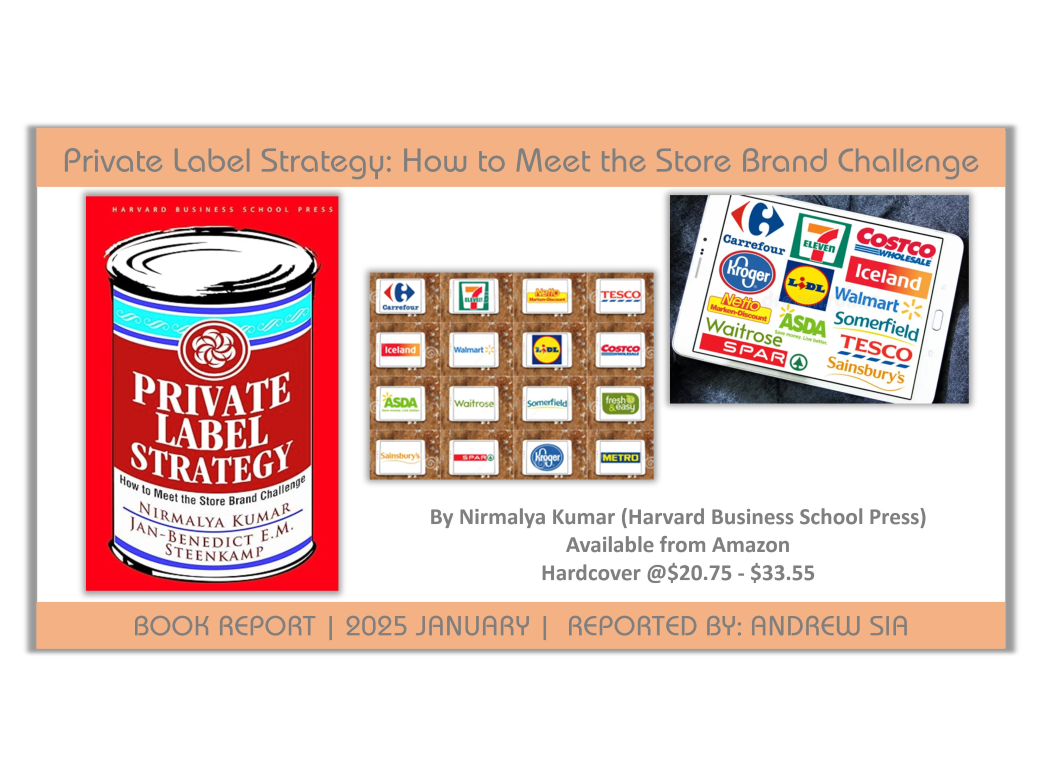
Book Report: Private Label Strategy: How to Meet the Store Brand Challenge
Available from Amazon
Author: NIRMALYA KUMAR (HARVARD BUSINESS SCHOOL PRESS)
Hardcover at @$20.75 – $33.55
Introduction
Definition of “Private Label” refers to products that are manufactured by one company but sold under another company’s brand. These products are often manufactured by third party manufacturers, packaged and shipped to the retailer, or the brand owner for selling.
The products are only exclusive to the retailer or the brand owner, and often they are more affordable because there is no “middleman” for markup. The retailers have control over quality, pricing, and branding from contents to final packaging.
In simple understanding that private label is exclusive to one retailer and products are customized. It is used widely across industries almost in every category. Private label is also a major part of the industry, especially for big retail chains, department stores, and it has now grown into online platforms.
Take clothing for instance, the private label fashion is an important part of the industry, and we can show you the private label brands used by the major retailers at this end of this report.
These brands are created for their own clothing lines and sold exclusively under their own store brand, giving them control over design, pricing and branding. They are often manufactured from overseas garment manufacturers.
Business in fashion private label the retailers can cut out licensing or wholesaler fees. Brand can create exclusive collections that draws customers’ acceptance, and often those iconic brands, like Zara and ASOS.
One thing that is important to know that because there is no third-party involvement, the retailers can obtain higher margins.
Fashion private labels need to hire independent fashion designers to develop full seasonal collections under strict guidelines, including fabric selection, trims, and accessories. It will require color directions and trend directions. There are manufacturers who are supplying multi fashion private label business where they have design team who continuously create and customized different styles for multi-brands.
Book Report
Private Label Strategy: How to Meet the Store Brand is based on the book by NIRMALYA KUMAR (HARVARD BUSINESS SCHOOL PRESS)
Private labels, also known as store brands or own brands, are products that are manufactured by one company but sold under another company’s brand—typically the retailer. These brands are usually offered alongside national brands but at a lower price.
Retailers can earn better margins because they control production flow and branding. The unique product lines help retailers to stand out. Once the private label brands have built their customer base, they can attract store traffic.
It is said that private labels are not just low-cost alternatives, they become strategic products. The better designs with the use of better fabrics and trims can put pressure on national brands by offering better value, creating premium store brands, and matching or exceeding national brands’ image.
All parties are looking for benefits, such as:
Retailer – Wants control over products, better margin, and customer loyalty.
Manufacturer – Seek for better volume, and long-term contract.
Consumer – Look for quality and price.
Trends in Fashion Private Label have developed in following areas:
Rise of Fast Fashion Retailers – Brands like Uniqlo, Zara, and H&M, operate largely on private label models, and use vertical integrated supply chains for speed. They work on the formula of speed-to-market.
Luxury Private Labels – High-end retailers like Net-a-Porter and Neiman Marcus now develop exclusive fashion lines.
DTC (Direct-to-Consumer) – Brands like Everlane and Allbirds act like private label but sell directly online, bypassing traditional retail markup.
Private label products are emphasizing ethical sourcing, recycle materials, and supply chain transparency to match consumer demand, especially the younger generation.
The use of artificial intelligence (AI), algorithm and big data to match private label offerings to shopper preferences.
When you come to the last part of the book, you will find all the potential retailers for you to explore and decide who you would like to promote your lines of products. It is international and I am sure that you can find some partners to work with.

Some typical examples for the Fashion Private Labels can be found on the retailers as the following chart:
